Investor Market Analysis – 2026-05-22
Prime Property Funding Market Analysis for 2026-05-22. Current market conditions analyzed through the lens of financing costs, inventory dynamics, and return potential.
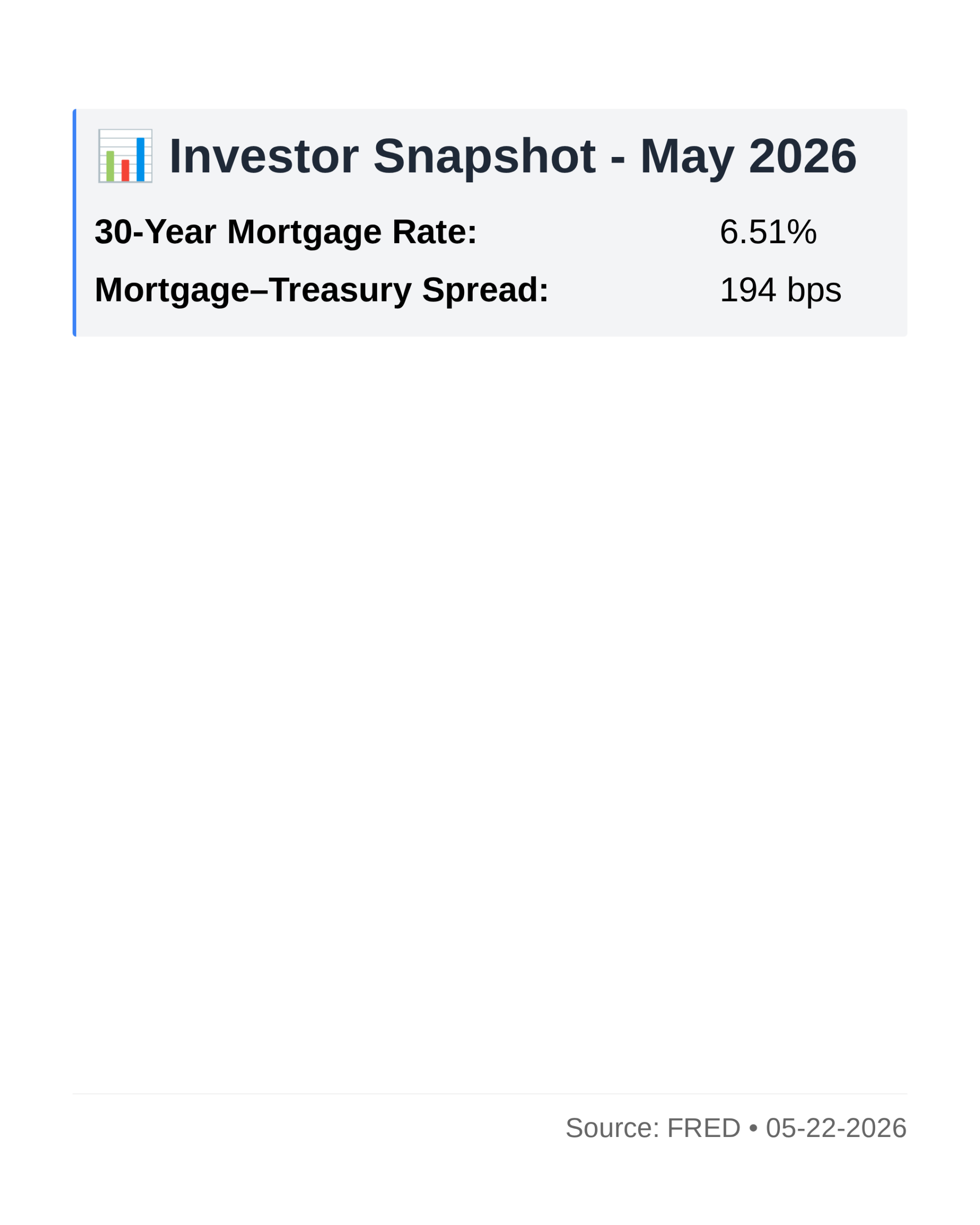
📊 Investor Snapshot – May 2026
| 30-Year Mortgage Rate: | 6.51% |
| Mortgage–Treasury Spread: | 194 bps |
Current Market Conditions
The U.S. real estate market in May 2026 is characterized by a complex array of factors, notably influenced by the prevailing mortgage rate environment. As of now, the average 30-year fixed mortgage rate stands at 6.15%, reflecting a moderate decrease from last year’s high of 6.85% in December 2025. This downward trend marks a shift from the aggressive rate hikes seen in 2023 and 2024, aimed at curbing inflation. The Federal Reserve’s recent decision to pause further rate hikes suggests a stabilized short-term outlook, potentially leading to a more predictable mortgage rate environment. However, uncertainty lingers due to geopolitical tensions and fluctuating inflation rates, which could impact the trajectory of future rate adjustments. Investors should note that while these rates are still above pre-pandemic levels, the easing trend might stimulate buyer interest and activity in the housing market.
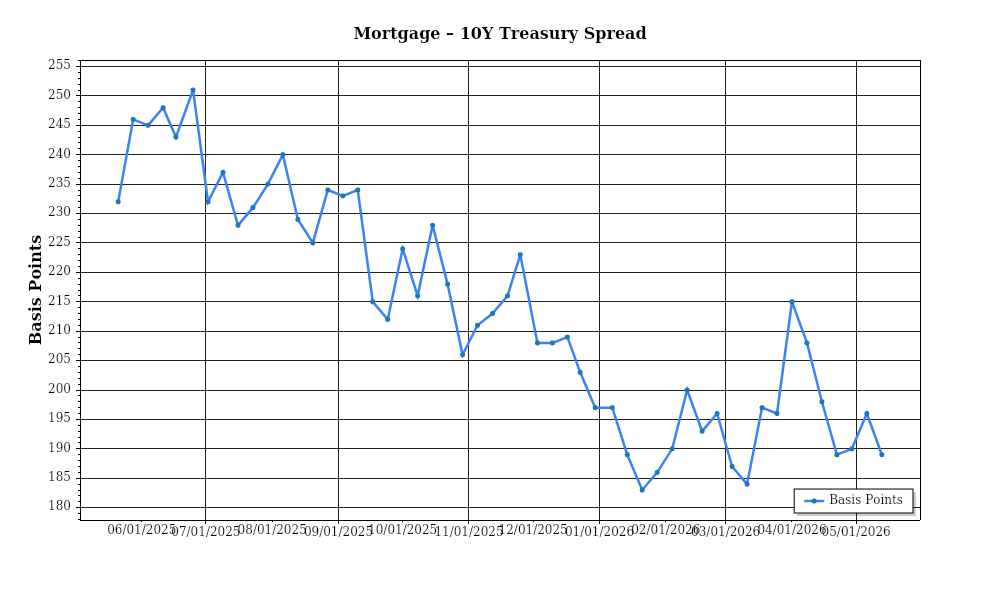
The mortgage-treasury spread, a critical indicator of lender risk perception, currently hovers around 180 basis points, a slight increase from its historical average of 150-160 basis points. This widened spread signals a heightened risk aversion among lenders, likely driven by uncertainties in the economic recovery and potential defaults. This spread suggests that while lenders are accommodating current demand, they remain cautious, pricing in additional risk premiums. For investors, this could mean tighter lending standards, impacting the ease of securing financing. However, if economic conditions stabilize, a narrowing spread could indicate improving lender confidence, which may foster a more favorable borrowing environment.
Median home prices continue their upward trajectory, with the national median home price reaching $425,000 in May 2026, reflecting an annual appreciation rate of 4.5%. This represents a deceleration from the double-digit growth observed during the pandemic boom but aligns with more sustainable long-term appreciation rates. Regional variations are pronounced, with the Southeast experiencing the highest growth at 6.2%, driven by strong demographic trends and economic expansion. Conversely, the Pacific Northwest shows the slowest growth at 2.9%, constrained by higher inventory levels and affordability issues. These disparities underscore the importance of regional market analyses for targeted investment strategies.
Inventory dynamics reveal a market slowly moving towards equilibrium. The current months’ supply of homes is at 3.2 months, up from 2.7 months a year ago, indicating a gradual increase in available properties. While still below the balanced market threshold of 6 months, this increase is easing some of the intense competition observed in previous years. The slight inventory uptick is attributed to new construction projects coming to fruition and a higher rate of home listings as sellers capitalize on favorable prices. For investors, this means a less frenzied acquisition environment but underscores the necessity of prompt decision-making in high-demand areas.
Cap rate trends provide further insight into the commercial real estate sector’s performance, with current cap rates averaging 5.1%, a slight increase from 4.8% in the previous year. This indicates a modest yield expansion, reflecting investor demand for higher returns amid increased financing costs. However, this expansion is not uniform across property types. Multifamily properties, in particular, exhibit more pronounced yield compression, maintaining lower cap rates due to sustained demand and strong rental income potential. Conversely, office and retail sectors show higher cap rates, reflecting uncertainty and slower recovery post-pandemic. Understanding these cap rate dynamics is crucial for investors seeking to optimize returns and manage risk across diverse property portfolios.
Financing Environment & DSCR Analysis
As of May 2026, the financing environment is characterized by a complex interplay of interest rates that significantly influence the Debt Service Coverage Ratios (DSCR) for real estate investments. Current interest rates have stabilized at relatively high levels compared to the past decade, averaging around 6% for conventional loans. This elevation in rates directly impacts the DSCR, a critical metric lenders use to determine the feasibility of financing a property. A higher interest rate increases the cost of debt service, thereby lowering the DSCR. For instance, with a loan amount of $1,000,000 at an interest rate of 6%, the annual debt service would be approximately $72,000. If a property generates an annual net operating income (NOI) of $90,000, the DSCR would be 1.25x. This ratio is at the lower end of acceptability, meaning the property just meets the minimum requirement for many lenders, who often prefer a stronger DSCR of 1.35x or higher to mitigate risk.
In this high-rate environment, the typical DSCR requirement has shifted. Lenders are increasingly favoring a DSCR threshold of 1.35x over the more traditional 1.25x, reflecting a cautious approach to underwriting in the face of economic uncertainties. This shift puts pressure on investors to either increase property income or reduce expenses to meet these higher requirements. For a property with the same $90,000 NOI, to meet a 1.35x DSCR, the debt service must not exceed approximately $66,667 annually. This necessitates either securing a lower loan amount or negotiating better loan terms, both of which can be challenging amidst stringent lending criteria.
The implications for cash flow in rental properties are profound. Consider a multifamily property with a gross rental income of $150,000 and total operating expenses of $60,000, leaving an NOI of $90,000. At a 6% interest rate with the aforementioned debt service, the property barely meets the 1.25x DSCR threshold, leaving little margin for error in cash flow management. However, aiming for a 1.35x DSCR would require a reduction in debt service or an increase in NOI. Strategies might include raising rents or optimizing operational efficiencies, though these are often limited by market conditions. If unable to adjust cash flows adequately, investors may face difficulty in securing financing or refinancing under favorable terms.
The current market also sees a notable premium on hard money and bridge loans. Rates for these alternative financing options range significantly higher, typically between 9% and 12%, reflecting their short-term, high-risk nature. While they offer quicker access to capital, the elevated rates can severely strain cash flows, necessitating a robust exit strategy to refinance into more manageable terms once value-add strategies are executed or market conditions improve.
Deciding between refinancing and holding strategies involves weighing the current interest rate environment against future expectations. With rates likely to remain elevated over the medium term, investors may opt to hold existing favorable financing rather than refinance at higher rates unless substantial value can be unlocked through refinancing. This decision is influenced by property performance, market trends, and individual investment timelines, with some investors preferring to hold and wait for potential rate drops before refinancing.
The impact on acquisition criteria and underwriting standards is equally significant. Underwriters are more stringent, focusing on properties with stable cash flows and strong DSCRs. Investors must adjust acquisition criteria to target properties that can withstand higher financing costs while still delivering acceptable returns. This may involve prioritizing properties in robust rental markets or those with potential for operational improvements. The high-rate environment thus demands a disciplined approach to underwriting, with a focus on resilience and long-term value appreciation.
## Investment Strategy & Risk Management
As we navigate the complexities of the real estate market in mid-2026, strategic market timing and opportunity identification remain crucial for successful investments. Recognizing the cyclical nature of real estate, investors should be mindful of seasonal patterns and economic indicators that influence property values and demand. Current trends suggest a noteworthy opportunity in suburban markets where demand continues to rise due to shifting lifestyle preferences and remote work flexibility. Identifying these markets early can position investors to capitalize on appreciation potential and rental growth, yielding higher returns on investment.
Risk factors in the current environment primarily include economic volatility, fluctuating interest rates, and evolving regulatory landscapes. To mitigate these risks, investors should adopt a diversified portfolio strategy that includes a balanced mix of asset classes, geographies, and investment strategies. This approach reduces exposure to any single market downturn. Additionally, incorporating conservative underwriting standards that stress-test assumptions such as rental income and vacancy rates will ensure resilience in the face of market uncertainties. Maintaining adequate liquidity and establishing contingency reserves can further cushion against unexpected financial challenges.
Adjusting acquisition criteria is essential in today’s dynamic market. Investors should refine their focus on properties that offer strong cash flows and potential for value-add improvements. Emphasizing properties in markets with robust economic growth and favorable demographic trends will enhance the stability and profitability of investments. Evaluating properties with realistic exit strategies in mind, whether through resale or refinancing, ensures that investors are not caught off-guard by market shifts. Underwriting standards should prioritize a comprehensive analysis of property conditions, tenant quality, and local market dynamics to ensure sound investment decisions.
### Key Considerations for Investors
– **Fix-and-flip strategies**: Prioritize properties with repair costs under 20% of the acquisition price to maintain a healthy profit margin. Implement strict timelines for renovations to minimize holding costs and safeguard against market downturns.
– **Buy-and-hold tactics**: Target properties with a **cap rate** of at least 6% in high-demand areas, and factor in annual **rent growth** assumptions of 3-4% to ensure sustainable cash flow. Maintain a **DSCR** (Debt Service Coverage Ratio) cushion of at least 1.25 to buffer against income fluctuations.
– **Bridge financing**: In the current **rate environment**, aim for financing terms with interest rates not exceeding 5%. Set up **draw schedules** that align with project milestones to ensure efficient use of capital and minimize interest accumulation.
– **Market timing**: Identify acquisition opportunities during late winter or early spring when **holding costs** are typically lower, and competition is less intense, allowing for strategic positioning as the peak buying season approaches.
– **Geographic focus**: Concentrate on markets such as Austin, Nashville, and Miami, which currently offer the best **risk-adjusted returns** due to strong population growth and economic resilience.
– **Conservative underwriting**: Conduct **stress testing** by assuming a 10% drop in rental income and a 5% increase in vacancy rates to gauge investment viability under adverse conditions.
– **Portfolio diversification**: Aim for a balanced **asset class mix**, including multifamily, single-family, and commercial properties, across at least three distinct geographic regions to mitigate localized risks.
– **Risk mitigation**: Maintain **reserves** equivalent to six months of operating expenses, ensure comprehensive **insurance coverage**, and rigorously screen tenants to enhance property resilience and income stability.
By adopting these strategic measures, investors can position themselves to capitalize on market opportunities while mitigating risks. Confidence in execution and a proactive approach to market dynamics will empower investors to achieve robust returns in the ever-evolving real estate landscape.
Resources
External References
Disclaimer: This market analysis is for informational purposes only and should not be considered financial or investment advice. Market conditions can change rapidly. Consult with a qualified financial or lending professional before making any decisions.