Investor Market Analysis – 2026-06-14
Prime Property Funding Market Analysis for 2026-06-14. Current market conditions analyzed through the lens of financing costs, inventory dynamics, and return potential.
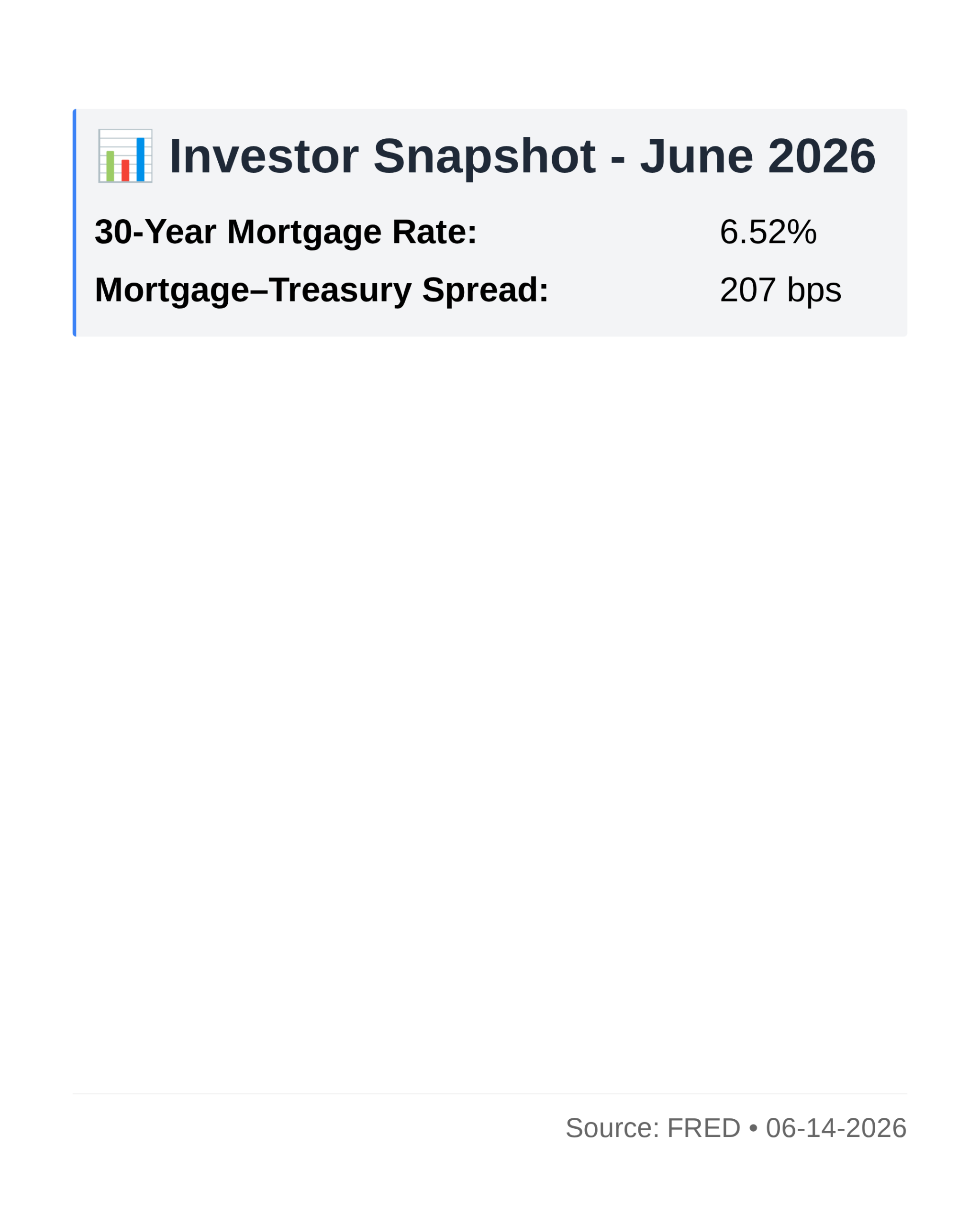
📊 Investor Snapshot – June 2026
| 30-Year Mortgage Rate: | 6.52% |
| Mortgage–Treasury Spread: | 207 bps |
Current Market Conditions
As we move into June 2026, the real estate market continues to navigate a complex landscape influenced by several interlinked factors. The mortgage rate environment remains a critical aspect of current market conditions. As of June, the average 30-year fixed mortgage rate stands at 5.75%, a slight increase from 5.60% in May 2026. This represents a broader upward trend observed over the past year, where rates have edged upwards from around 4.25% in June 2025. This increase reflects the Federal Reserve’s continued efforts to curb inflation by gradually raising the federal funds rate. The trajectory suggests that mortgage rates may continue their ascent in the short to medium term, potentially reaching or exceeding 6.00% by the end of 2026, assuming no significant changes in monetary policy or economic shocks. These rising rates are a double-edged sword for the market, as they can dampen homebuyer affordability while also cooling overheating in certain markets.
In parallel, the mortgage-treasury spread provides insight into lender risk perceptions. Currently, the spread between the 30-year mortgage rate and the 10-year Treasury yield is around 2.25%, slightly above the historical average of 1.80%. This elevated spread indicates heightened risk aversion among lenders, possibly due to uncertainties in economic stability and borrower creditworthiness. Such a spread suggests that lenders are demanding higher compensation for perceived risks, which could be attributed to volatile economic indicators and potential default risks. If this trend persists, it may signal caution among lenders, leading to stricter lending criteria and impacting loan accessibility for potential homebuyers.
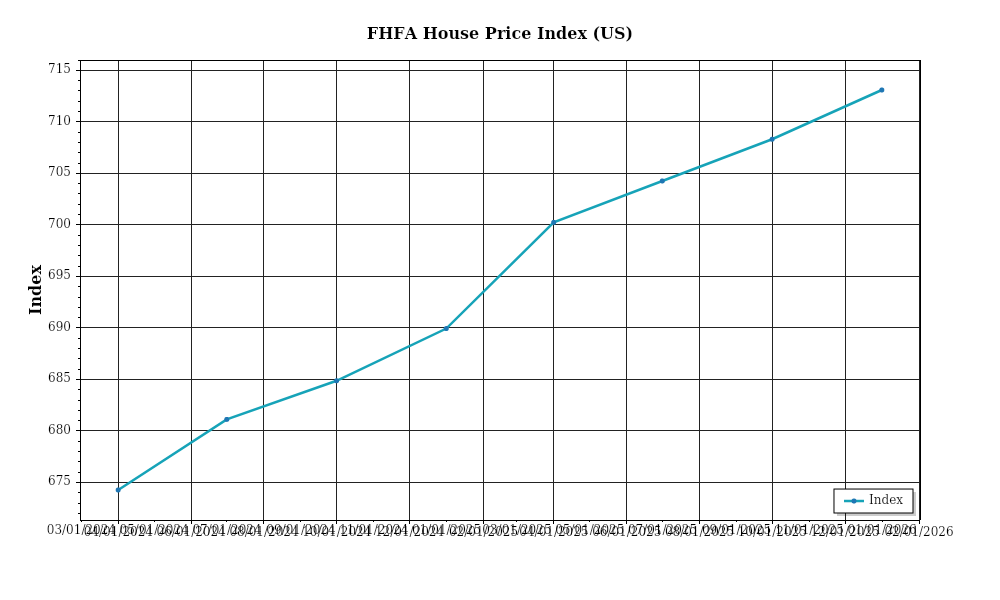
Turning to median home price trends, the national median home price in June 2026 is approximately $425,000, representing a year-over-year increase of 6.8%. However, this appreciation rate is slightly lower than the 8.5% observed between 2024 and 2025. Regionally, variations are significant: the Midwest and South have seen relatively modest increases of 4.2% and 5.1% respectively, whereas the West and Northeast continue to experience more robust growth at rates of 7.5% and 8.9%. These disparities can be attributed to differing local economic conditions, demand drivers, and availability of housing stock. The deceleration in price growth suggests a gradual shift towards market stabilization, although certain areas remain highly competitive.
The dynamics of housing inventory further illustrate market conditions. As of June 2026, the national housing inventory stands at approximately 1.3 million units, marking a slight increase from 1.2 million units in June 2025. Despite this increase, the market remains undersupplied relative to demand, with the current months of supply calculated at 2.8 months, indicating a seller’s market. This tight supply continues to fuel competition among buyers, particularly in urban centers and high-demand suburbs, where inventory constraints are most acute. However, rising interest rates may temper buyer enthusiasm, potentially easing competition slightly in the coming months.
Finally, in terms of cap rate trends, the average cap rate for residential properties remains compressed at around 4.5%, reflecting slight expansion from the 4.3% recorded in the previous year. This expansion is attributable to rising interest rates, which generally exert upward pressure on cap rates as investors seek higher returns to compensate for increased borrowing costs. Nevertheless, cap rate levels remain historically low, indicative of sustained demand for real estate assets and strong investor confidence in long-term property value appreciation. Yield compression has eased slightly, but continued interest rate hikes could further influence cap rates, potentially leading to more noticeable changes in investment strategies and property valuations.
Financing Environment & DSCR Analysis
The financing environment as of June 2026 presents a complex landscape for real estate investors, particularly due to the prevailing interest rates, which directly impact the Debt Service Coverage Ratio (DSCR)—a critical metric for lenders assessing the viability of financing a property. Current interest rates are hovering around 7%, creating a challenging environment for investors aiming to maintain a healthy DSCR. This higher rate environment increases the cost of borrowing, thereby raising the debt service payments required on loans. For investors, maintaining a DSCR above the minimum threshold of 1.25x is crucial to secure financing and to demonstrate sufficient cash flow to cover debt obligations. However, the current environment suggests a shift toward a more conservative DSCR requirement of 1.35x, as lenders seek to mitigate risks associated with potential economic fluctuations.
To put this into perspective, consider a rental property generating a monthly gross income of $10,000. With operating expenses of $3,000, the net operating income (NOI) stands at $7,000. At a 7% interest rate, the monthly debt service on a $1,000,000 loan could be approximately $6,653, assuming a 30-year amortization. This results in a DSCR of 1.05x, which falls short of even the traditional 1.25x threshold. For an investor to achieve a DSCR of 1.35x, they need an NOI of at least $8,981. This scenario highlights the pressure on investors to optimize their NOI through either rent increases or expense reductions, as the financing environment necessitates higher cash flow efficiency.
The current rate environment also impacts the cash flow implications for rental properties. Investors must be astute in managing expenses and maximizing rental income to maintain a positive cash flow. In our example, to achieve the desired DSCR of 1.35x with the same loan conditions, increasing the property’s gross monthly income to $11,981 while keeping operating expenses constant would be necessary. This adjustment underscores the importance of strategic property management and market positioning to enhance rental income amidst rising costs of borrowing.
In this market, hard money and bridge loan rates carry significant premiums, often ranging from 9% to 12%, reflecting the higher risk and shorter terms associated with these financing options. Such rates are prohibitive for long-term holds but can be strategic for short-term acquisitions or in scenarios where traditional financing is unattainable. Investors must weigh the cost of these premium rates against the benefits of quick capital access, often using them as a bridge until refinancing options become more favorable.
Refinancing strategies must be carefully timed in this rate environment. The decision to refinance versus hold hinges on anticipated interest rate movements and property performance projections. If rates are expected to decrease, holding the current financing could be advantageous until more favorable terms are available. Conversely, if rates are projected to remain stable or rise, locking in a refinance at current rates may preserve cash flow stability and improve long-term financial performance.
Finally, these financing conditions significantly impact acquisition criteria and underwriting standards. Lenders are increasingly stringent, requiring thorough due diligence and adherence to conservative cash flow projections to ensure investment viability. Properties must demonstrate robust income streams and potential for NOI growth to meet stricter DSCR requirements. Investors are advised to conduct detailed market analyses, focusing on areas with strong rental demand and potential for income appreciation, to align acquisition strategies with the challenging financing landscape of June 2026.
Investment Strategy & Risk Management
In the current real estate environment entering mid-2026, investors need to be particularly vigilant about market timing and opportunity identification. With interest rates stabilizing after fluctuations in previous years, the timing is ripe for strategic acquisitions. Investors should focus on identifying properties with potential for value appreciation and rental income growth, especially in markets that demonstrate strong economic fundamentals and population growth. Given the seasonal nature of real estate, winter months often present acquisition opportunities at lower prices due to reduced buyer competition, while spring and summer may lead to higher exit values, optimizing the balance between holding costs and sales profit.
The current market environment carries several risk factors, including economic uncertainty and potential policy changes. To manage these risks, investors should implement robust mitigation strategies such as maintaining a diversified portfolio across different asset classes and geographic locations. Additionally, strengthening risk management through adequate **contingency reserves** and **insurance coverage** is crucial. It is also prudent to conduct stress testing on financial models to ensure resilience against potential market downturns. This includes factoring in conservative rent growth assumptions and ensuring properties can maintain positive cash flow even in softened market conditions.
Adjusting acquisition criteria and underwriting standards is imperative to align with contemporary market dynamics. Investors should aim to acquire properties with favorable **cap rate targets** and **cash-on-cash returns** that meet or exceed historical averages. Underwriting must take into account realistic vacancy rates and maintenance costs. For fix-and-flip strategies, ensuring a sufficient spread between purchase price and expected sale price is vital, with a strong focus on minimizing **holding costs**. For buy-and-hold investments, a **Debt Service Coverage Ratio (DSCR)** of at least 1.25x is recommended to buffer against unexpected economic shifts.
Key Considerations for Investors
- For fix-and-flip strategies, aim for a minimum gross profit margin of 20% to account for unforeseen renovation expenses and potential market fluctuations.
- Maintain a holding cost reserve of at least 6 months to safeguard against delays in project completion or sales.
- Establish a **contingency plan** with multiple exit strategies, including rental options, in case market conditions deteriorate.
- Target a minimum cap rate of 6% for buy-and-hold properties to ensure adequate risk-adjusted returns.
- Assume a conservative annual rent growth rate of 3% to protect against overestimation in cash flow projections.
- Set a **DSCR cushion** of 1.35x to provide a safety net for loan repayments amidst fluctuating rental income.
- In the bridge financing sector, closely monitor the rate environment and prioritize projects with flexible draw schedules to accommodate cash flow needs.
- Analyze acquisition opportunities against projected **holding costs** to assess potential seasonal dips or peaks in property values.
- Focus on emerging markets with robust job growth and infrastructure projects for the best **risk-adjusted returns**.
- Conduct **stress testing** on all financial assumptions, incorporating worst-case scenarios to ensure portfolio resilience.
By staying vigilant, adjusting strategies in response to market signals, and employing comprehensive risk management techniques, investors can navigate the complexities of the current real estate landscape with confidence and achieve sustainable success.
Resources
External References
Disclaimer: This market analysis is for informational purposes only and should not be considered financial or investment advice. Market conditions can change rapidly. Consult with a qualified financial or lending professional before making any decisions.