Investor Market Analysis – 2026-05-26
Prime Property Funding Market Analysis for 2026-05-26. Current market conditions analyzed through the lens of financing costs, inventory dynamics, and return potential.
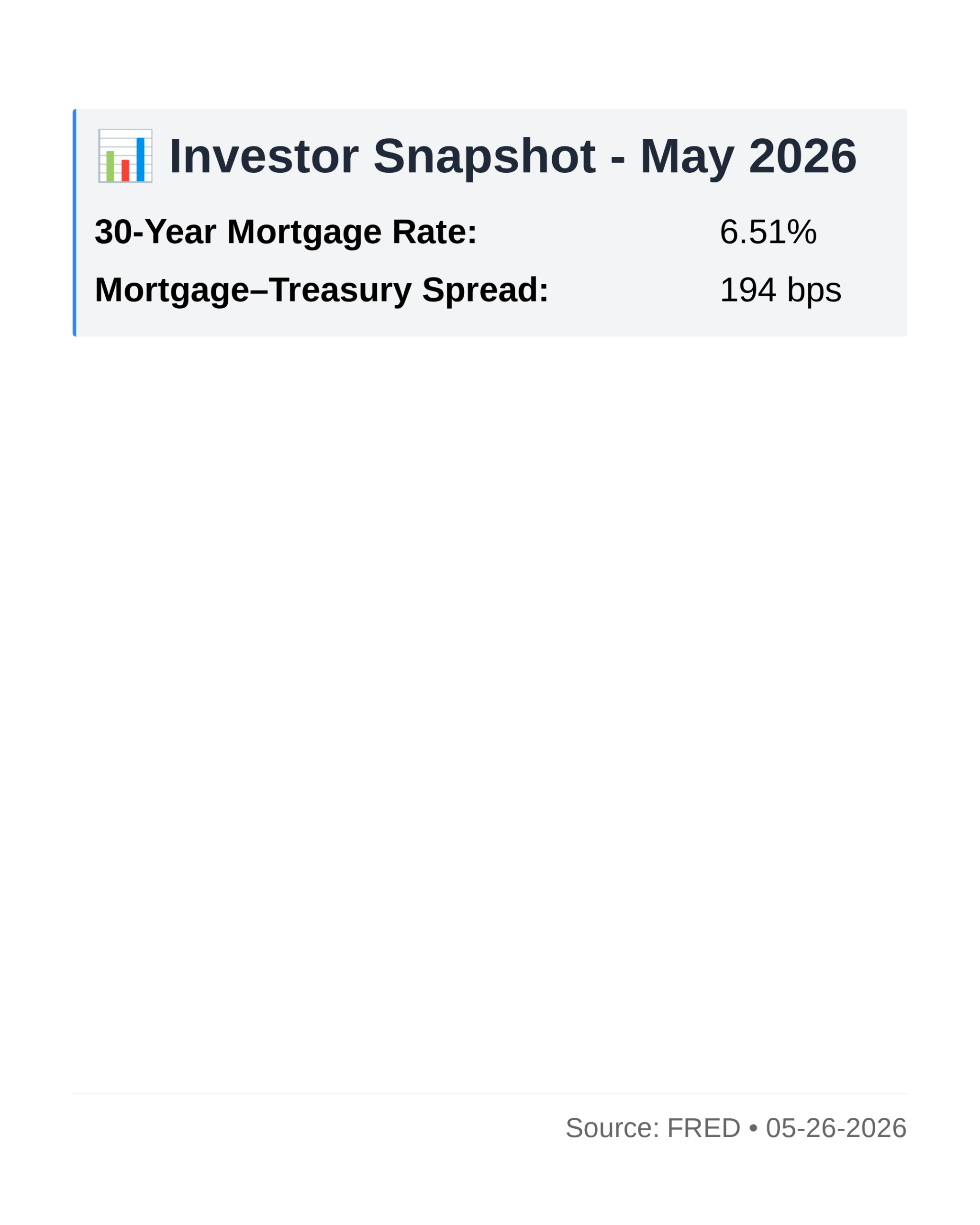
📊 Investor Snapshot – May 2026
| 30-Year Mortgage Rate: | 6.51% |
| Mortgage–Treasury Spread: | 194 bps |
Current Market Conditions
As of May 2026, the mortgage rate environment exhibits a complex dynamic influenced by ongoing economic factors and Federal Reserve policy shifts. The average 30-year fixed mortgage rate currently stands at 6.2%, reflecting a slight increase from 5.9% in April 2026. This trend marks a subtle upward trajectory observed since late 2025, driven by persistent inflationary pressures and the Fed’s tightening measures to counteract these pressures. In the short term, the trajectory of mortgage rates is expected to remain upward, albeit at a moderated pace, as current economic indicators suggest a gradual stabilization in inflation rates. This environment poses challenges for potential homebuyers, as higher mortgage rates translate into increased monthly payments, potentially dampening purchasing power.
The mortgage-treasury spread, a critical indicator of lender risk perception, has widened to 2.3%, up from 2.0% in the preceding month. This spread, representing the difference between the average 30-year fixed mortgage rate and the yield on the 10-year Treasury note, signals heightened risk aversion among lenders. The current 10-year Treasury yield hovers around 3.9%, remaining relatively stable, which indicates that the widening spread is largely driven by lenders’ concerns over economic volatility and potential borrower defaults. In practical terms, this increased spread implies that lenders are demanding a higher risk premium, which could further constrain credit availability for less creditworthy borrowers, impacting overall mortgage origination volumes.
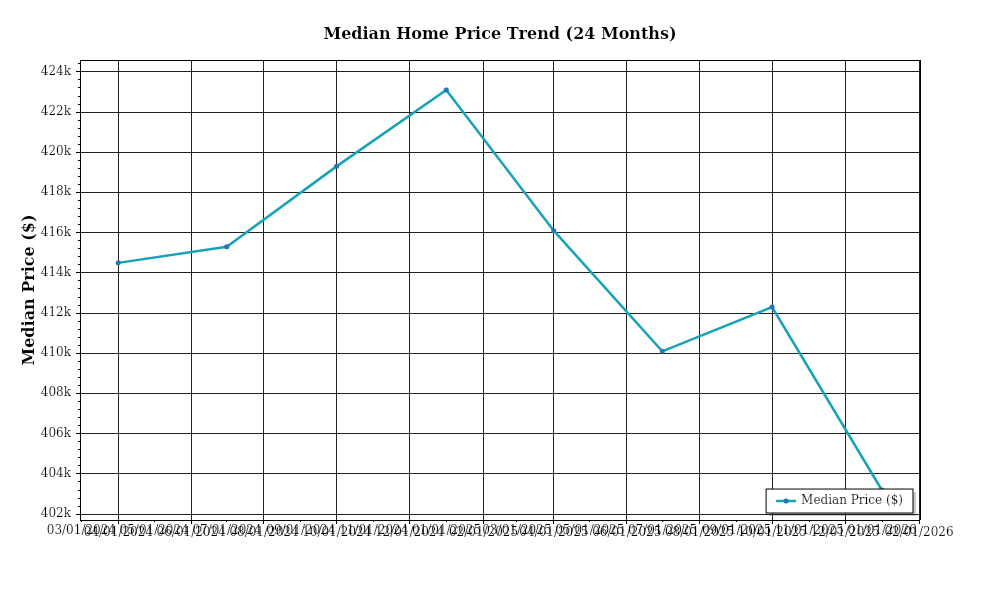
Analyzing median home price trends, the national median home price is currently at $398,000, representing a year-over-year appreciation rate of 5.5%. This rate is a deceleration from the 7.3% observed the previous year, reflecting a cooling of the rapid price gains witnessed during the pandemic years. Regional variations are pronounced, with the Western markets, particularly in cities like San Francisco and Seattle, experiencing minimal appreciation, around 2.1%, due to affordability challenges. In contrast, Southeastern markets, such as Atlanta and Charlotte, continue to see robust appreciation rates above 8%, fueled by strong job growth and population influx. These trends suggest a shift towards a more balanced market as supply gradually catches up with demand in certain regions.
Inventory dynamics remain a crucial factor in market balance. The current housing inventory is approximately 2.5 months of supply, slightly up from 2.2 months at the beginning of the year. While this indicates a modest increase in available homes for sale, the market still leans towards a seller’s market, as a balanced market typically requires around 5-6 months of supply. The competition for acquisitions remains intense, particularly in high-demand urban areas and emerging suburban markets. This heightened competition is reflected in the average days on market, which has decreased to 28 days, down from 35 days a year ago, underscoring the urgency among buyers to secure properties swiftly.
Cap rate trends, reflecting the relationship between property income and its value, show signs of slight expansion. Nationally, the average cap rate has increased to 5.1% from 4.7% in the previous quarter. This expansion suggests that property values are adjusting more slowly relative to income growth, potentially signaling an end to the intense yield compression observed over the past few years. In practical terms, this means investors may find slightly more attractive entry points in certain markets, particularly those experiencing slower appreciation. However, the expansion is not uniform across all asset classes, with multifamily properties in high-growth areas still facing relatively compressed cap rates due to sustained demand and stable rental income streams. This nuanced cap rate environment requires investors to be discerning in their market and asset class selection, balancing potential returns with evolving market conditions.
Financing Environment & DSCR Analysis
As of May 2026, the financing environment is characterized by persistently high-interest rates, a consequence of the Federal Reserve’s ongoing measures to manage inflation. These elevated rates significantly impact Debt Service Coverage Ratios (DSCR), a critical metric for lenders assessing the viability of commercial real estate loans. With current average interest rates on commercial mortgages hovering around 7%, the ability of rental properties to generate sufficient cash flow to cover debt obligations is increasingly strained. A higher interest expense translates to a lower DSCR, challenging property owners to meet traditional lending thresholds.
In the current climate, lenders typically require a minimum DSCR of 1.25x, though more conservative institutions may demand up to 1.35x to buffer against potential cash flow disruptions. This means that for every dollar of debt service, a property must generate $1.25 to $1.35 in net operating income (NOI). Given these stringent requirements, investors must diligently analyze potential acquisitions to ensure compliance. For example, a rental property with a monthly debt service of $10,000 must generate at least $12,500 to $13,500 in NOI to satisfy lender requirements. Properties failing to meet these thresholds may face difficulties in securing financing, necessitating higher equity contributions or alternative financing arrangements.
For rental property investors, these DSCR requirements have substantial cash flow implications. Consider a multi-family property with a gross rental income of $20,000 per month and operating expenses of $7,000, resulting in an NOI of $13,000. With a debt service requirement of $10,000, the DSCR is 1.3x, just above the minimum threshold. However, should interest rates rise further, increasing the debt service to $11,000, the DSCR would fall to approximately 1.18x, below many lenders’ acceptable limits. This scenario highlights the precarious balance investors must maintain between income and expenses to ensure financial viability in a high-rate environment.
In this context, hard money and bridge loans emerge as viable, albeit costly, alternatives for investors unable to secure traditional financing. These loans are typically priced at a premium, with interest rates ranging from 9% to 12% depending on borrower risk profile and asset quality. While they offer quick access to capital, the higher rates further compress DSCR, necessitating rigorous cash flow management to avoid default. Investors might consider these options for short-term financing needs, particularly when repositioning a property to improve cash flow before refinancing into a lower-cost, long-term loan.
The decision between refinancing and holding assets hinges on the anticipated trajectory of interest rates and the investor’s strategic objectives. In the current high-rate environment, refinancing may lock in higher costs and lower DSCR, potentially jeopardizing cash flow. Conversely, holding off on refinancing until rates stabilize or decrease may preserve cash flow, albeit with the risk of missing favorable market conditions. Investors must weigh these factors, potentially delaying refinancing in favor of value-add strategies that enhance NOI and improve DSCR.
Finally, the current rate environment compels a shift in acquisition criteria and underwriting standards. Investors are urged to adopt more conservative assumptions, including higher interest rate projections and lower leverage ratios, to withstand potential financial pressures. Properties with stable, predictable cash flows, such as those with long-term, creditworthy tenants, are increasingly attractive. Moreover, rigorous stress testing of financial models to simulate various interest rate and occupancy scenarios is essential to ensure resilience against future market fluctuations.
In conclusion, the high-interest rate environment of May 2026 imposes significant challenges for real estate investors, particularly concerning DSCR compliance and cash flow management. By understanding and adapting to these conditions, investors can strategically navigate the market to optimize their portfolios.
Investment Strategy & Risk Management
In the current real estate landscape, characterized by fluctuating interest rates and shifting demand dynamics, timing is paramount for maximizing investment returns. Investors must be keenly aware of market cycles and be prepared to capitalize on opportunities that present themselves during periods of market correction or growth. In 2026, as we navigate through a post-pandemic economic readjustment, the window for strategic acquisitions is open but requires precision and agility. Identifying opportunities in undervalued markets or distressed properties can offer significant upside potential. However, this requires a disciplined approach to market analysis and a readiness to act swiftly when favorable conditions emerge.
Risk factors in today’s environment include potential interest rate hikes, inflationary pressures, and geopolitical uncertainties. To mitigate these risks, investors should employ a diversified strategy that balances short-term gains with long-term stability. For instance, hedging against interest rate volatility can be achieved by locking in low fixed rates where possible or utilizing interest rate caps. Inflation can erode returns, so it’s crucial to focus on assets that can adjust rental rates accordingly. Additionally, diversifying across asset classes and geographic regions can buffer against localized economic downturns.
Adjusting acquisition criteria and underwriting standards is essential in this climate. Investors should prioritize assets with strong fundamentals, such as properties in high-demand areas with robust job growth and population inflows. Underwriting standards must be stringent, incorporating stress tests that account for various economic scenarios. It is advisable to maintain conservative loan-to-value (LTV) ratios and ensure sufficient debt service coverage ratios (DSCR) to cushion against potential revenue fluctuations. Emphasizing quality over quantity in property acquisitions can safeguard against market volatility.
For Prime Property Funding, focusing on robust underwriting and emphasizing risk-adjusted returns will remain pivotal. This entails a comprehensive evaluation of borrower credentials, property conditions, and market trends. By aligning investment strategies with these rigorous standards, investors can enhance their portfolio’s resilience and achieve sustainable growth.
Key Considerations for Investors
- Fix-and-flip strategies: Maintain a minimum profit margin of 20% after accounting for holding costs and renovation expenses to buffer against unexpected market shifts.
- Exit timing: Plan for a maximum holding period of 6 months to mitigate exposure to market volatility and holding costs.
- Buy-and-hold tactics: Target a minimum cap rate of 6% in urban areas to ensure adequate returns adjusted for risk.
- Rent growth assumptions: Use conservative growth rates of 2-3% annually to reflect current economic conditions and tenant affordability.
- DSCR cushions: Aim for a DSCR of at least 1.25 to provide a safety margin against income fluctuations.
- Bridge financing: Establish contingency reserves equal to 10% of the project cost to cover unforeseen expenses or delays.
- Market timing: Prioritize acquisitions in Q1 and Q3 to leverage seasonal market trends and optimize transaction timing.
- Geographic focus: Concentrate on emerging markets with strong population growth, such as Austin and Raleigh, for superior risk-adjusted returns.
- Conservative underwriting: Stress test assumptions with a 10% drop in property values and rental income to ensure feasibility under adverse conditions.
- Risk mitigation: Allocate at least 5% of the property value in reserves and ensure comprehensive insurance coverage to safeguard investments.
By adhering to these strategic guidelines and remaining vigilant in market analysis, investors can navigate the complexities of the current environment with confidence, positioning themselves for success and resilience in the evolving real estate landscape.
Resources
External References
Disclaimer: This market analysis is for informational purposes only and should not be considered financial or investment advice. Market conditions can change rapidly. Consult with a qualified financial or lending professional before making any decisions.