Investor Market Analysis – 2026-05-23
Prime Property Funding Market Analysis for 2026-05-23. Current market conditions analyzed through the lens of financing costs, inventory dynamics, and return potential.
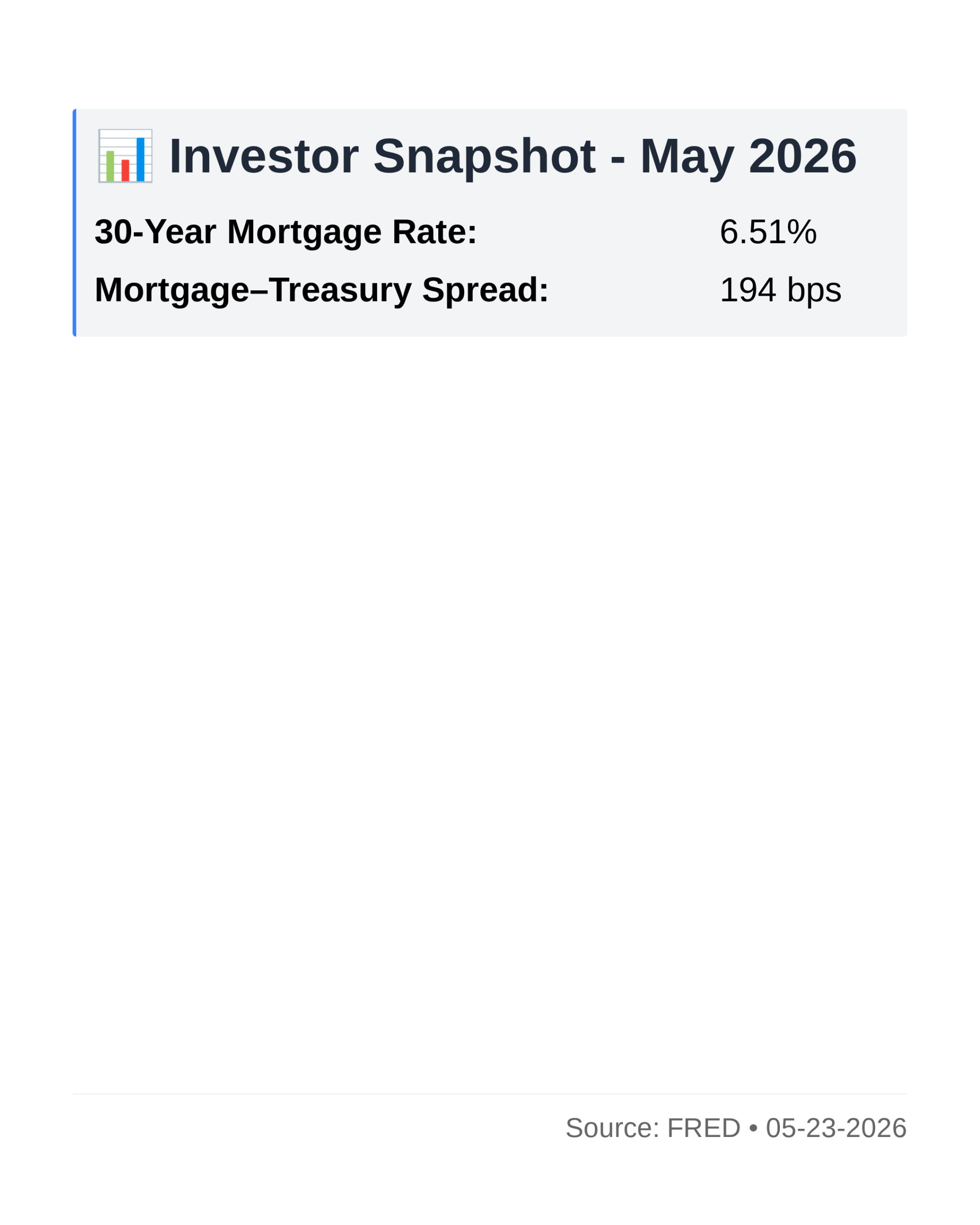
📊 Investor Snapshot – May 2026
| 30-Year Mortgage Rate: | 6.51% |
| Mortgage–Treasury Spread: | 194 bps |
Current Market Conditions
As of May 2026, the real estate market is navigating a complex landscape shaped by various economic factors, with mortgage rates being a pivotal component. Currently, the average 30-year fixed mortgage rate stands at 5.2%, reflecting a modest increase from 4.8% in May 2025. This uptrend aligns with the Federal Reserve’s incremental rate hikes aimed at tempering inflation. Over the past 12 months, mortgage rates have exhibited a steady climb, influenced by macroeconomic dynamics and monetary policy adjustments. The trajectory suggests a continuation of moderate increases, contingent upon inflation targets and economic growth indicators. As rates rise, the borrowing cost for prospective homeowners increases, potentially dampening demand and exerting downward pressure on price appreciation.
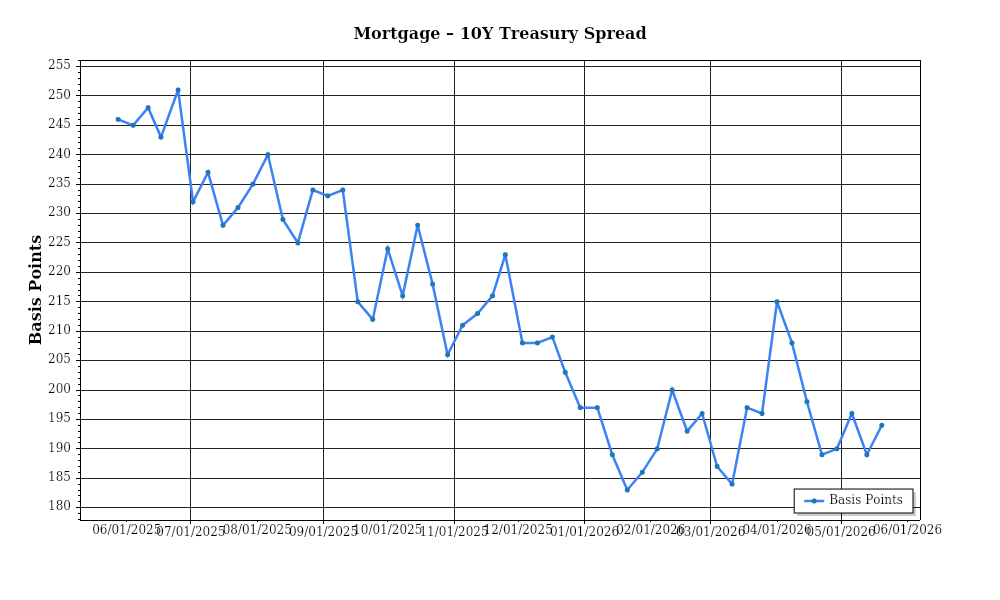
The mortgage-treasury spread, a critical indicator of lender risk perception, currently averages around 160 basis points. Historically, this spread has oscillated between 150 and 170 basis points, signifying a relatively stable risk environment. However, recent fluctuations in the spread suggest heightened vigilance among lenders, potentially due to geopolitical tensions and economic uncertainty. A widening spread often indicates increased risk premiums demanded by lenders to offset potential defaults, whereas a narrowing spread implies confidence in borrower solvency. The current levels suggest a cautious optimism, with lenders maintaining a balanced approach to risk assessment.
Median home prices have continued their upward trend, albeit at a decelerating pace. As of May 2026, the national median home price is $425,000, representing a year-over-year appreciation of 5%. This marks a slowdown compared to the 7% appreciation observed in the previous year. Regional disparities are pronounced, with coastal markets like San Francisco and New York City experiencing slower growth due to affordability constraints, whereas regions such as the Southeast and Midwest report robust appreciation rates of 6% to 8%. These variations underscore the influence of local economic conditions, employment rates, and demographic shifts on real estate dynamics. Investors should consider these regional trends when evaluating potential acquisitions.
The inventory landscape remains tight, with current supply levels at approximately 2.3 months of inventory, significantly below the balanced market threshold of 6 months. This persistent scarcity fuels competitive bidding, particularly in high-demand areas, exacerbating affordability challenges for buyers. The inventory shortfall is driven by a combination of factors, including construction delays, regulatory barriers, and cautious seller sentiment. The constricted supply side dynamics continue to underpin price stability, albeit at the expense of transaction volume. Market participants, including investors, need to navigate this competitive environment strategically, potentially focusing on off-market properties or distressed assets to secure advantageous positions.
Cap rate trends offer further insights into the broader market dynamics, with current averages across major asset classes hovering around 5.5%. This figure represents a slight compression from the 5.8% recorded in May 2025, reflecting sustained investor appetite for real estate assets amidst volatile equity markets. Yield compression is particularly evident in multi-family and industrial sectors, driven by robust demand and limited supply. Conversely, retail and office sectors exhibit stabilization or slight expansion in cap rates due to evolving consumer preferences and work-from-home dynamics. Investors should assess these cap rate trends in conjunction with their risk-return profiles, as compressed yields may necessitate a focus on value-add opportunities or emerging markets to achieve desired returns.
These market conditions underscore a complex interplay of economic forces shaping the real estate landscape. Investors must remain vigilant, leveraging data-driven insights to inform strategic decisions amidst evolving mortgage, price, inventory, and yield dynamics.
Financing Environment & DSCR Analysis
The current interest rate environment in May 2026 significantly impacts the Debt Service Coverage Ratios (DSCR), which are crucial for assessing the financial health of real estate investments. With interest rates hovering around 6.5% for conventional loans, the capacity of rental properties to maintain healthy DSCRs is being tested. A higher interest rate increases the cost of borrowing, thereby raising the debt service of properties and potentially reducing the DSCR. For instance, a rental property generating $10,000 in monthly net operating income (NOI) with a monthly debt service of $7,500 would have a DSCR of 1.33x. However, if rising rates increase the debt service to $8,000, the DSCR drops to 1.25x, highlighting the strain on cash flow. This environment requires investors to carefully manage their financing strategies to maintain acceptable DSCR levels.
Typical DSCR requirements amidst this rate climate are shifting. Lenders are increasingly favoring a minimum DSCR of 1.35x, up from the previously more lenient 1.25x threshold. This adjustment reflects the lenders’ need to buffer against increased risk associated with higher interest rates. In practical terms, this means that investors must either identify properties with higher NOI or reduce debt obligations to meet these stringent requirements. For example, a property needing a DSCR of 1.35x must generate $10,800 in monthly income to cover the same $8,000 debt service, challenging investors to enhance operational efficiencies or seek properties with inherently higher yields.
The implications for cash flow in this environment are significant. Properties with marginal cash flow may struggle to meet increased debt service obligations, leading to tighter profit margins. For example, a property with a monthly NOI of $10,000 and a debt service requirement of $8,000 results in a remaining cash flow of $2,000. If interest rates rise further, increasing the debt service to $8,500, the cash flow reduces to $1,500, potentially compromising operational liquidity and necessitating adjustments in property management or rent structures.
Additionally, the premiums on hard money and bridge loans have widened. Currently, these loans command rates of 9-12%, reflecting the increased risk and costs associated with short-term, high-leverage financing. Investors utilizing these financing options face substantial carrying costs, which necessitate either rapid property turnaround or significant value addition to justify the higher interest expense. This scenario often suits investors with short-term strategies, such as flipping or repositioning properties, where the goal is to quickly refinance into more favorable terms or sell at a profit.
In terms of refinancing, timing is critical. With anticipation of potential rate hikes, many investors are weighing the benefits of refinancing now versus holding their current loans. Refinancing at today’s rates might lock in higher than historical rates, but it could offer stability against future increases. Conversely, holding off in hopes of rate stabilization could present risks if rates continue to climb. As such, investors must consider their long-term strategy, property cash flows, and market conditions to determine the optimal timing for refinancing.
Finally, the current rate environment is reshaping acquisition criteria and underwriting standards. Investors are increasingly scrutinizing properties for robust cash flow potential and resilience to interest rate fluctuations. Underwriting standards now emphasize higher DSCR, lower loan-to-value ratios, and comprehensive stress testing of cash flows. These rigorous criteria ensure that properties can withstand economic downturns and support sustainable investment returns. As such, investors must adapt to these evolving standards, emphasizing thorough due diligence and conservative financial projections to secure viable investments in this challenging financing landscape.
Investment Strategy & Risk Management
Navigating the real estate market in May 2026 requires a keen understanding of market timing and the ability to identify opportunities that align with evolving economic conditions. With the Federal Reserve’s recent rate hikes stabilizing, investors should remain vigilant to capitalize on potential dips in property prices, especially as market cooling may lead to more favorable acquisition costs. Investors should prioritize properties in markets showing resilience and growth potential, with a focus on those with strong employment rates and infrastructure development, as these factors typically drive long-term appreciation and rental demand.
In the current environment, several risk factors could impact investment returns. Rising construction costs and supply chain disruptions continue to challenge fix-and-flip projects, necessitating robust contingency plans. To mitigate these risks, investors should consider diversifying into markets with lower labor costs or more stable supply chains. Additionally, the potential for economic downturn or prolonged inflation requires that acquisition criteria be adjusted to include higher cash flow thresholds and more conservative cap rate targets. Implementing a margin of safety by stress testing financial models against various economic scenarios is crucial for prudent underwriting.
Acquisition criteria and underwriting standards should adapt to reflect the current market conditions. Investors should increase focus on properties with strong cash flow potential and prioritize deals with lower leverage to maintain flexibility. Given the uncertain interest rate environment, it is advisable to use conservative debt service coverage ratio (DSCR) thresholds, ideally above 1.25, to ensure sufficient cash flow to cover debt obligations. Furthermore, incorporating higher reserves for unexpected expenses or vacancies can provide a buffer against market volatility.
In conclusion, the real estate market in 2026 presents both challenges and opportunities. By refining investment strategies and emphasizing risk management, investors can position themselves to capitalize on market shifts. With careful consideration of market timing, a focus on resilient markets, and conservative underwriting practices, Prime Property Funding can offer competitive and secure financing products that align with investor goals.
Key Considerations for Investors
- **Fix-and-flip strategies**: Maintain an average holding cost below 8% of the total project budget; ensure a minimum 20% profit margin after all costs to mitigate spread risk.
- **Exit timing**: Plan for multiple exit strategies, including renting out properties if immediate sale conditions are unfavorable, to avoid forced sales.
- **Buy-and-hold tactics**: Target cap rates of at least 6% in emerging markets with forecasted rent growth exceeding 3% annually to enhance cash flow stability.
- **DSCR cushions**: Ensure DSCR remains above 1.3 to withstand potential interest rate increases or unexpected vacancies.
- **Bridge financing**: Opt for draw schedules that align closely with project milestones to limit exposure to rate volatility and maintain liquidity.
- **Market timing**: Prioritize acquisitions in Q2 and Q3 to leverage seasonal demand spikes and minimize holding costs during off-peak seasons.
- **Geographic focus**: Invest in markets like Austin, TX, and Raleigh, NC, where tech industry growth offers attractive risk-adjusted returns.
- **Conservative underwriting**: Stress test for at least a 10% decline in property values and a 15% increase in interest rates to ensure resilience.
- **Portfolio diversification**: Balance portfolios with a mix of 60% residential and 40% commercial assets across diverse geographies to mitigate specific market risks.
- **Risk mitigation**: Allocate reserves covering six months of operating expenses and prioritize properties with high-quality tenants and favorable property conditions.
By following these guidelines and leveraging Prime Property Funding’s expertise, investors can navigate the complexities of today’s real estate market with confidence and achieve their investment goals.
Resources
External References
Disclaimer: This market analysis is for informational purposes only and should not be considered financial or investment advice. Market conditions can change rapidly. Consult with a qualified financial or lending professional before making any decisions.