Investor Market Analysis – 2026-04-27
Prime Property Funding Market Analysis for 2026-04-27. Current market conditions analyzed through the lens of financing costs, inventory dynamics, and return potential.
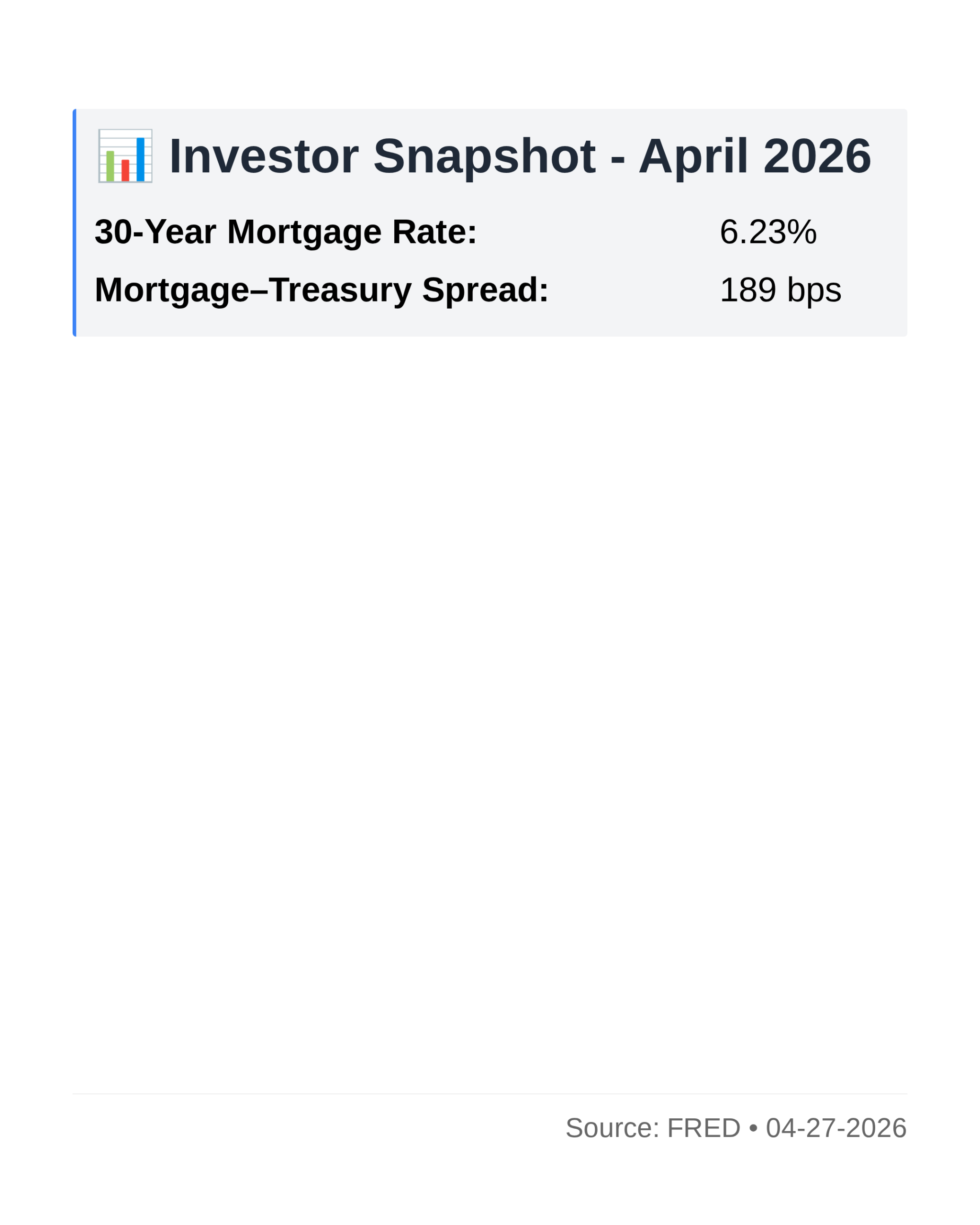
📊 Investor Snapshot – April 2026
| 30-Year Mortgage Rate: | 6.23% |
| Mortgage–Treasury Spread: | 189 bps |
Current Market Conditions
As of April 2026, the mortgage rate environment has been marked by significant fluctuations, influenced by both domestic and global economic factors. Currently, the average 30-year fixed mortgage rate stands at 5.8%, a modest increase from 5.5% in January 2026. Over the past twelve months, rates have seen a steady climb from 4.9% in April 2025, reflecting a combination of inflationary pressures and Federal Reserve policy adjustments aimed at stabilizing economic growth. The Federal Reserve’s cautious stance on interest rates suggests that mortgage rates may see further incremental increases throughout the year, potentially reaching 6.0% by December 2026. This upward trajectory is likely to impact affordability, particularly for first-time homebuyers, and could dampen demand if wage growth does not keep pace with rising borrowing costs.
The mortgage-treasury spread, a critical indicator of lender risk perception, is currently at 1.8%, slightly above the historical average of 1.5%. This widening spread indicates a higher risk premium demanded by lenders, possibly due to increased market volatility and economic uncertainty. The spread has expanded from 1.6% recorded six months ago, which aligns with the recent global geopolitical tensions and concerns over a potential economic slowdown. This risk premium suggests that lenders are pricing in higher default risks, which could lead to tighter credit conditions. For investors, this means a more cautious lending environment where securing favorable financing may become more challenging unless economic conditions stabilize.
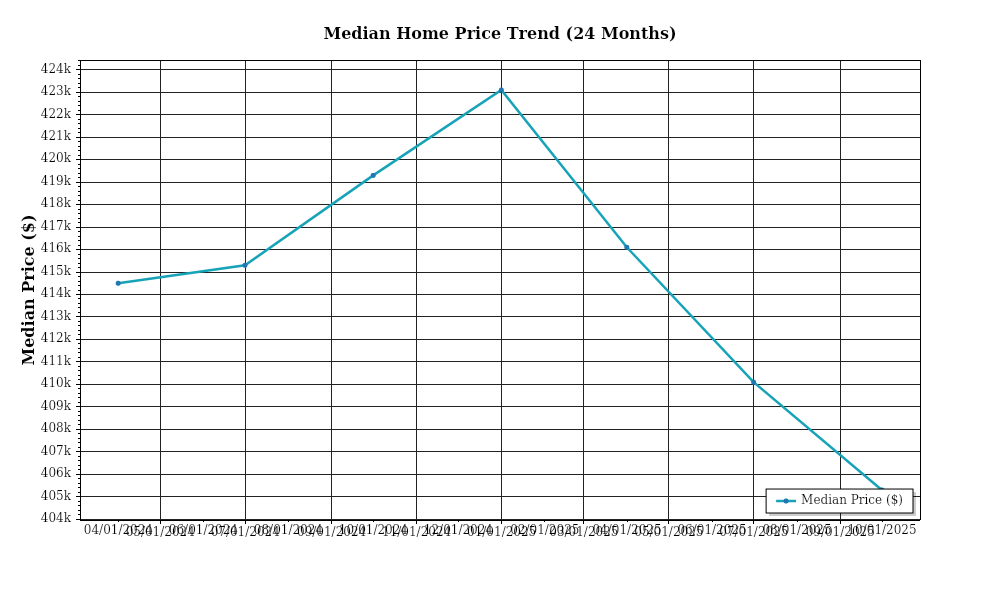
Median home prices continue to exhibit strong upward momentum, with the national median home price reaching $415,000 in April 2026, a 6.5% increase from the previous year. The appreciation rate has moderated slightly from the 8.2% annual growth recorded in 2025, indicating a potential softening in price acceleration. Regionally, the West Coast remains the most expensive market, with median prices in cities like San Francisco and Los Angeles surpassing $1.2 million, while the Midwest offers more affordable options with median prices around $290,000. This regional variation underscores the importance of localized market analysis, as areas with lower price points may offer better entry opportunities for investors seeking higher yields amid rising national price averages.
Inventory dynamics reveal a market still grappling with supply constraints, with the current housing inventory at 1.2 million units, representing a 2.5-month supply at current sales rates. This figure is below the balanced market threshold of a 4-6 month supply, signifying a continued seller’s market. The competition for acquisitions remains fierce, particularly in metropolitan areas where demand outpaces supply. New construction has been slow to fill the gap, with builders facing rising material costs and labor shortages, further exacerbating supply challenges. For investors, this tight inventory situation necessitates strategic acquisitions and may prompt interest in alternative asset classes or markets with less competitive pressure.
Cap rate trends highlight a landscape of yield compression, with average cap rates for prime multifamily properties declining to 4.1%, down from 4.4% in April 2025. This compression is primarily driven by strong investor demand in a low-yield environment, where traditional fixed-income investments offer limited returns. This trend indicates that while property prices continue to rise, the potential for return on investment in terms of income is diminishing. Investors may need to adjust acquisition strategies, focusing on value-add opportunities or secondary markets where cap rates are more favorable. The ongoing yield compression suggests a competitive marketplace where securing attractive deals requires astute market insight and analysis.
Financing Environment & DSCR Analysis
As of April 2026, the interest rate landscape is markedly affecting the Debt Service Coverage Ratios (DSCR) for real estate investors. With prevailing mortgage rates hovering around 6.5% for conventional loans, the cost of borrowing has increased, thereby impacting the DSCR. The DSCR, which measures a property’s ability to cover its debt obligations with its net operating income (NOI), is crucial for securing financing. A higher interest rate generally results in higher monthly debt payments, thus requiring a property to generate more income to meet the same DSCR. For instance, a property that previously serviced a $500,000 loan at 4% with a monthly payment of $2,387 now faces a payment of approximately $3,160 at 6.5%, necessitating a higher NOI to maintain the same DSCR.
In the current environment, lenders are generally adhering to stricter DSCR requirements. While the minimum standard threshold has traditionally been 1.25x, many lenders are now demanding a DSCR of 1.35x or higher to offset the perceived risks associated with economic volatility and higher interest rates. This change means that a property generating $10,000 monthly in NOI would need to cover at least $7,407 in debt service to meet the 1.35x threshold, compared to $8,000 in debt service coverage required under a 1.25x threshold. This adjustment in criteria can significantly affect investor strategies, particularly for those looking to refinance or acquire new properties.
The cash flow implications for rental properties are significant. The increased cost of debt service reduces the available cash flow that can be reinvested or taken as profit. For example, assuming an NOI of $120,000 annually, a property with a 1.25x DSCR under previous conditions could support annual debt service of $96,000. With current rate conditions, maintaining a 1.35x DSCR may limit the debt service to $88,888, effectively reducing the amount of leverage available and necessitating either a higher NOI or additional equity to bridge the gap. This reality pushes investors to explore operational efficiencies or rental increases to sustain their cash flow objectives.
The rates for hard money and bridge loans have been particularly volatile. These loans, used primarily for short-term financing, are seeing premiums as high as 3-4% above traditional financing, pushing rates into the 10-12% range. This premium reflects the heightened risk and the short-term nature of such loans. Consequently, investors utilizing hard money or bridge financing must be acutely aware of the increased carrying costs and ensure that their projects can achieve the necessary returns to justify these expenses. This environment demands precise exit strategies, often involving refinancing into lower-cost, long-term debt once the property stabilizes.
Deciding between refinance timing and hold strategies is critical in this rate environment. With rates projected to stabilize or potentially decrease in the coming years, many investors are opting to hold their current financing arrangements, waiting for more favorable conditions. However, those under pressure to refinance due to loan maturities may need to accept higher rates temporarily, potentially using interest-only periods to mitigate cash flow impacts. This strategy, while not ideal, can preserve liquidity until market conditions improve.
Finally, the current financing landscape is reshaping acquisition criteria and underwriting standards. Investors must exercise increased diligence in underwriting, ensuring that properties not only meet higher DSCR requirements but also possess growth potential to withstand economic shifts. Cap rates have started to adjust, albeit not as quickly as interest rates, leading to tighter margins. As such, acquisitions now demand a more conservative approach, with greater emphasis on location, tenant quality, and lease terms to ensure resilience against financial fluctuations.
Investment Strategy & Risk Management
In the rapidly shifting real estate market of 2026, investors must remain vigilant in identifying opportunities while managing inherent risks. Market timing is crucial, especially for those engaging in fix-and-flip projects, where the difference between profit and loss can hinge on the timing of acquisitions and sales. With interest rates projected to stabilize but potentially increase later in the year, securing properties at favorable terms is essential. Investors should consider targeting properties that are undervalued due to temporary market conditions, such as seasonal slowdowns or macroeconomic uncertainties. This approach allows for acquisitions at lower costs with the potential for significant upside as market conditions improve.
Risk factors in the current environment include potential interest rate hikes, fluctuating property values, and increased construction costs. To mitigate these risks, investors should implement robust due diligence processes and stress-testing in their financial models. This includes preparing for various scenarios, such as a slowdown in rent growth or an unexpected increase in holding costs. Diversifying portfolios geographically and across asset classes can also reduce exposure to localized economic downturns.
Adjusting acquisition criteria and underwriting standards is necessary to navigate the evolving landscape. Investors should prioritize properties with strong fundamentals, such as high demand areas with low vacancy rates. Underwriting standards should incorporate conservative assumptions, such as modest appreciation rates and higher-than-expected expense ratios. By tightening these criteria, investors can better manage risks and ensure that only the most promising opportunities are pursued.
To conclude, maintaining a balanced approach that incorporates both aggressive opportunity identification and prudent risk management will be essential for investors in 2026. By focusing on market timing, risk mitigation, and strategic adjustments, investors can position themselves to capitalize on the current market dynamics while safeguarding their investments.
Key Considerations for Investors
- For fix-and-flip strategies, aim for a minimum gross margin of 20% to account for holding costs and potential market fluctuations.
- Incorporate a minimum contingency reserve of 10% of the total project cost to cover unexpected expenses.
- Set cap rate targets for buy-and-hold properties at least 1% higher than the national average to ensure competitive returns.
- Assume rent growth at a conservative 2-3% annually to buffer against potential stagnation in income.
- Ensure a DSCR cushion of 1.25 or higher to withstand periods of lower-than-expected cash flows.
- For bridge financing, negotiate draw schedules that align with project milestones to better manage cash flow and minimize interest costs.
- Prioritize markets with historical appreciation rates above 5% annually for best risk-adjusted returns.
- Implement stress testing for underwriting assumptions by modeling scenarios with up to 15% lower rental income and 10% higher expenses.
- Maintain a diverse portfolio with no more than 30% exposure to any single market or asset class to reduce systemic risk.
- Enhance risk mitigation by ensuring adequate insurance, maintaining high tenant quality, and regularly assessing property condition.
In this dynamic market, disciplined strategies combined with proactive risk management empower investors to both seize opportunities and safeguard their portfolios against potential downturns.
Resources
External References
Disclaimer: This market analysis is for informational purposes only and should not be considered financial or investment advice. Market conditions can change rapidly. Consult with a qualified financial or lending professional before making any decisions.