Investor Market Analysis – 2026-04-21
Prime Property Funding Market Analysis for 2026-04-21. Current market conditions analyzed through the lens of financing costs, inventory dynamics, and return potential.
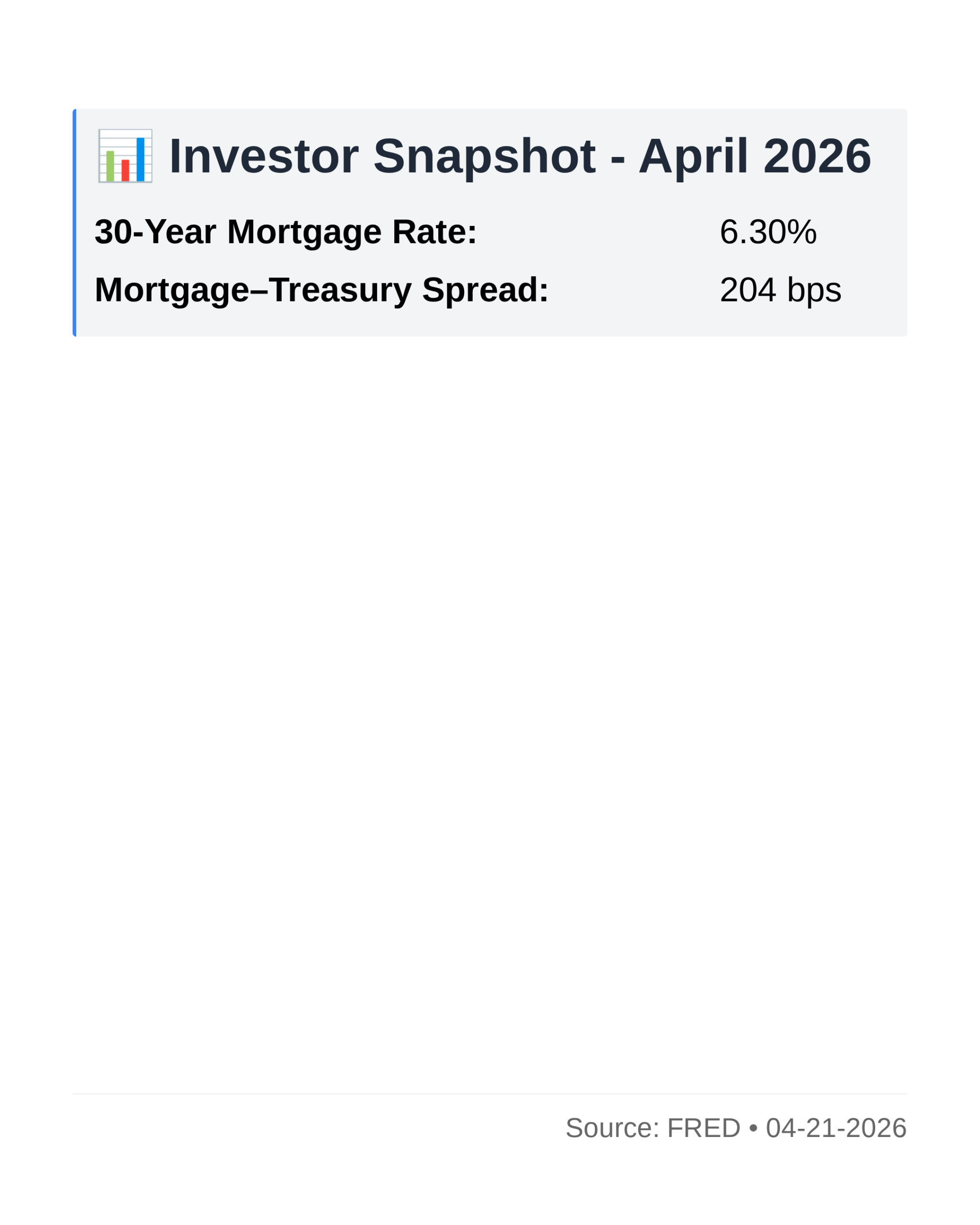
📊 Investor Snapshot – April 2026
| 30-Year Mortgage Rate: | 6.30% |
| Mortgage–Treasury Spread: | 204 bps |
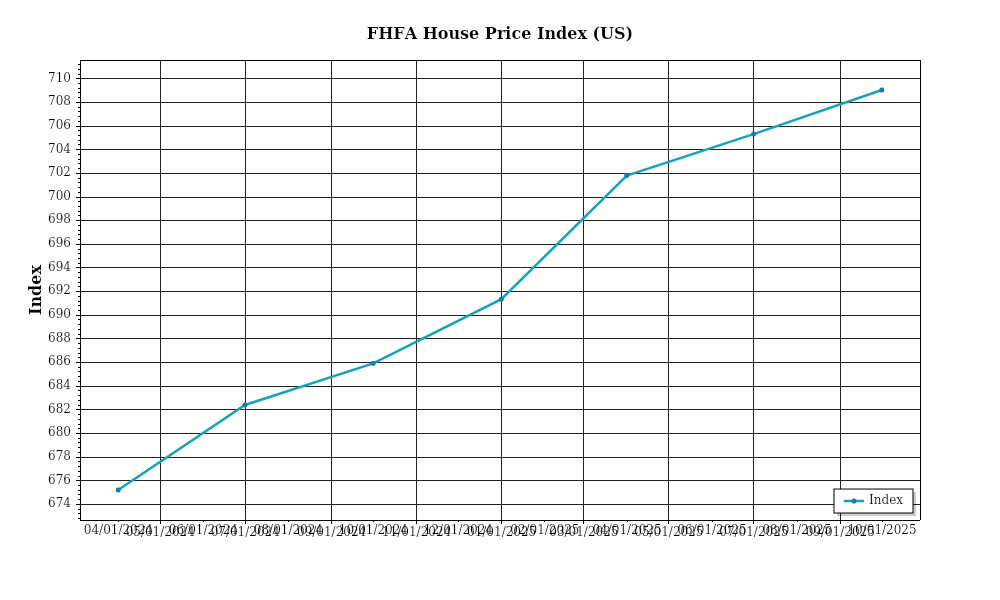
Current Market Conditions
As of April 2026, the mortgage rate environment is experiencing a period of relative stability, following a tumultuous few years marked by significant fluctuations. Currently, the average 30-year fixed mortgage rate stands at 5.25%, a modest decrease from the 5.50% observed in December 2025. This downward trend has provided some relief to prospective homebuyers, although rates remain higher than the 3.75% seen in early 2022. The Federal Reserve’s recent decision to maintain the federal funds rate at 4.50% is aimed at curbing inflation, suggesting that mortgage rates may remain stable in the near term. Analysts predict that any future adjustments will be gradual, contingent upon economic indicators such as inflation rates and employment figures. The current trajectory hints at a plateau, with little expectation of rates returning to pre-pandemic lows.
When examining the mortgage-treasury spread, which measures the difference between mortgage interest rates and the yield on 10-year Treasury notes, we observe a spread of approximately 175 basis points as of April 2026. This figure has narrowed from the 200 basis points seen in mid-2025, indicating a decrease in lender risk perception. Typically, a wide spread signals heightened risk aversion among lenders, often due to economic uncertainty. The current narrowing suggests increased confidence in the housing market’s stability and the broader economy. However, with geopolitical tensions and inflationary pressures still present, the spread could widen if economic conditions deteriorate.
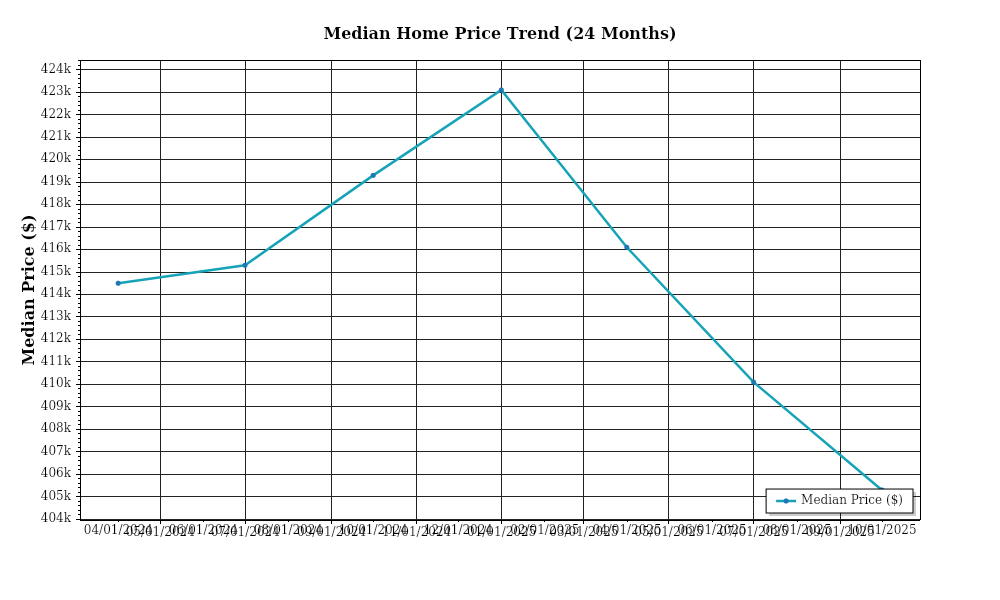
The national median home price continues to demonstrate robust growth, with the current median price at $410,000, reflecting an annual appreciation rate of 8%. This is a deceleration from the 12% growth experienced in 2024, indicating a cooling yet still active market. Regional variations are pronounced, with the Sunbelt states, including Texas and Florida, seeing double-digit appreciation rates of 10% to 12%, driven by strong population growth and job creation. Conversely, some Midwestern areas report more modest increases of 4% to 5%, reflecting slower economic activity. Coastal markets such as California and New York, traditionally high-demand areas, continue to experience price increases around 7%, albeit with signs of plateauing due to affordability constraints.
Inventory dynamics reveal a market that remains tilted slightly in favor of sellers, although conditions are moving towards equilibrium. Total housing inventory at the end of March 2026 was 1.45 million units, up 10% from the same period last year, offering some respite from the historically low levels that characterized the post-pandemic surge in demand. Despite this increase, the months’ supply of homes sits at 3.5 months, below the balanced market benchmark of 6 months. This indicates ongoing competition among buyers, although less fierce than during the peak pandemic years. The increased inventory can be attributed to both an uptick in new construction and slower absorption rates, as higher interest rates somewhat dampen buyer enthusiasm.
Cap rate trends provide insight into the investment landscape, with the average cap rate for multifamily properties currently at 5.1%, a slight increase from 4.8% in 2025. This shift suggests a gradual yield expansion, reflecting investors’ cautious optimism. The increase in cap rates can be interpreted as a reaction to rising interest rates and potential economic slowdowns, which increase the cost of capital and risk premiums. Conversely, office and retail sectors continue to experience yield compression, driven by demand for prime assets and repositioning strategies aimed at adapting to changing work and consumption patterns. Investors may find opportunities in sectors and regions where cap rates have expanded, signaling potential for higher returns as market conditions stabilize.
Financing Environment & DSCR Analysis
As of April 2026, the financing environment for real estate investments is primarily characterized by fluctuating interest rates that have a direct impact on Debt Service Coverage Ratios (DSCR). Currently, interest rates are averaging around 6.5%, which is a significant increase from the historically low rates seen in the early 2020s. This rise in rates directly affects the DSCR, a crucial metric used by lenders to assess the risk of a loan. The DSCR is calculated by dividing the net operating income (NOI) by the debt service. With higher interest rates, the cost of debt service increases, requiring properties to have a higher NOI to maintain the same DSCR. For instance, if a property generates an NOI of $100,000 annually and the debt service is $80,000, the DSCR would be 1.25x. However, with increased interest rates pushing the debt service to $90,000, maintaining a DSCR of 1.25x would necessitate an NOI of $112,500.
In this environment, lenders are increasingly cautious. The typical DSCR requirements have shifted more commonly to the higher end of the spectrum, with many lenders insisting on a minimum DSCR of 1.35x, as opposed to the 1.25x threshold that was more prevalent during periods of lower rates. This shift is a response to the increased risk of default that accompanies higher interest obligations. A property that previously met a 1.25x DSCR with an NOI of $125,000 and a debt service of $100,000 would now need an NOI of $135,000 to satisfy a 1.35x DSCR. This requirement can limit the pool of properties considered viable by investors and necessitates more rigorous financial underwriting.
The implications for cash flow in rental properties are substantial. Higher debt service costs can erode cash flow, leaving less room for unforeseen expenses or economic downturns. For example, consider a multifamily property with an annual rental income of $500,000. After accounting for operating expenses of $250,000, the NOI stands at $250,000. If the debt service increases from $200,000 to $225,000 due to rising rates, the cash flow drops from $50,000 to $25,000 annually. Investors must scrutinize their cash flow projections carefully, as thinner margins increase financial vulnerability and reduce flexibility.
In the current market, hard money and bridge loan rates carry a premium due to their short-term nature and the higher risk they represent. These loans, often used for property flipping or transitional financing, now attract rates between 10% and 12%, compared to the 8% to 10% range seen in previous years. The elevated rates reflect both the increased risk premium demanded by lenders and the competitive demand for these financing options. For investors relying on these loans, the cost implications mean tighter profit margins and the need for more precise project timelines to ensure profitability.
The decision between refinancing or holding properties is increasingly nuanced in this rate environment. With rates having risen, the timing of refinancing becomes critical. Those who locked in lower rates before the increase may find holding more advantageous, avoiding the higher costs associated with new debt. Conversely, properties with adjustable-rate mortgages or those acquired at the current high rates may benefit from refinancing should rates stabilize or decrease. This strategic timing can significantly impact long-term investment returns and requires careful consideration of projected interest rate trends.
Finally, the current financing climate significantly affects acquisition criteria and underwriting standards. Investors and lenders alike are recalibrating their approaches to ensure that acquisitions are financially viable under higher rate conditions. This recalibration often involves more conservative assumptions about rental growth and expense management, as well as stricter scrutiny of location and market dynamics. As a result, properties that may have been attractive in a lower-rate environment could now fall short of the necessary financial thresholds, prompting investors to either adjust their acquisition criteria or seek out more creative financing solutions.
Investment Strategy & Risk Management
In the current real estate market, investors need to be astute about timing and identifying opportunities, as the landscape is rapidly changing. With interest rates stabilizing after previous hikes, the window for optimized acquisitions is opening, particularly in high-demand urban and suburban areas. Investors should leverage this period to acquire properties at slightly reduced prices, foreseeing appreciation as market dynamics stabilize. By focusing on properties that require moderate rehabilitation, investors can take advantage of the fix-and-flip strategy, which remains viable given the ongoing shortage in housing supply. However, it’s vital to monitor economic indicators, such as employment rates and consumer confidence, which could impact demand and price trajectories.
Risk factors are ever-present in today’s environment, with inflationary pressures and potential economic slowdowns being primary concerns. To mitigate these risks, investors should prioritize liquidity and maintain healthy cash reserves. This practice ensures flexibility in unforeseen downturns or delays in project timelines. Additionally, diversification across different asset classes and geographic locations can buffer against localized market disruptions. Adjusting acquisition criteria to focus on properties with strong fundamental value and potential for cash flow generation will also aid in weathering economic uncertainties.
Acquisition criteria and underwriting standards should be tailored to current market conditions. Investors should employ conservative assumptions in their financial models, particularly regarding projected rent increases and property appreciation rates. Stress testing these assumptions against various economic scenarios will provide insights into potential vulnerabilities. The underwriting process should factor in higher-than-average vacancy rates and operating expenses to accommodate any unexpected market shifts. By adopting a rigorous due diligence approach, investors can ensure that acquisition decisions are well-grounded and financially sound.
As investors navigate this period, the emphasis should be on strategic, data-driven decision-making. By aligning investment strategies with market realities and adopting a proactive risk management approach, investors can capitalize on emerging opportunities while safeguarding their portfolios against volatility. This balanced approach will empower investors to derive maximum value from their investments as the market evolves.
Key Considerations for Investors
- For fix-and-flip strategies, aim for a minimum spread of 20% between purchase, renovation, and resale prices to buffer against cost overruns and market fluctuations.
- Anticipate holding costs by budgeting for at least six months of expenses to cushion against delays in project completion or market entry challenges.
- Target buy-and-hold properties with a cap rate of no less than 6% to ensure sufficient return on investment in a competitive market.
- Employ conservative rent growth assumptions of 2-3% annually to align with inflationary trends and avoid overestimating income projections.
- For DSCR loans, maintain a DSCR cushion of at least 1.25 to safeguard against income disruptions, ensuring loan servicing capability.
- Consider bridge financing with interest rates capped at 8% to balance cost with financial leverage, and set clear exit strategies such as refinancing or property sale timelines.
- Evaluate market timing by analyzing seasonal patterns; historically, spring and early fall present optimal acquisition opportunities due to increased buyer activity.
- Focus on markets with strong job growth and population increases for the best risk-adjusted returns, targeting areas with consistent demand.
- Conduct stress testing on all underwriting assumptions to account for potential economic downturns, ensuring viability under adverse conditions.
- Enhance portfolio diversification by incorporating a mix of residential, commercial, and mixed-use properties across multiple geographic regions to mitigate localized risks.
In conclusion, by implementing these strategic approaches, real estate investors can effectively manage risks and seize opportunities, ensuring robust portfolio performance in the current market landscape.
Resources
External References
Disclaimer: This market analysis is for informational purposes only and should not be considered financial or investment advice. Market conditions can change rapidly. Consult with a qualified financial or lending professional before making any decisions.