Investor Market Analysis – 2026-03-17
Prime Property Funding Market Analysis for 2026-03-17. Current market conditions analyzed through the lens of financing costs, inventory dynamics, and return potential.
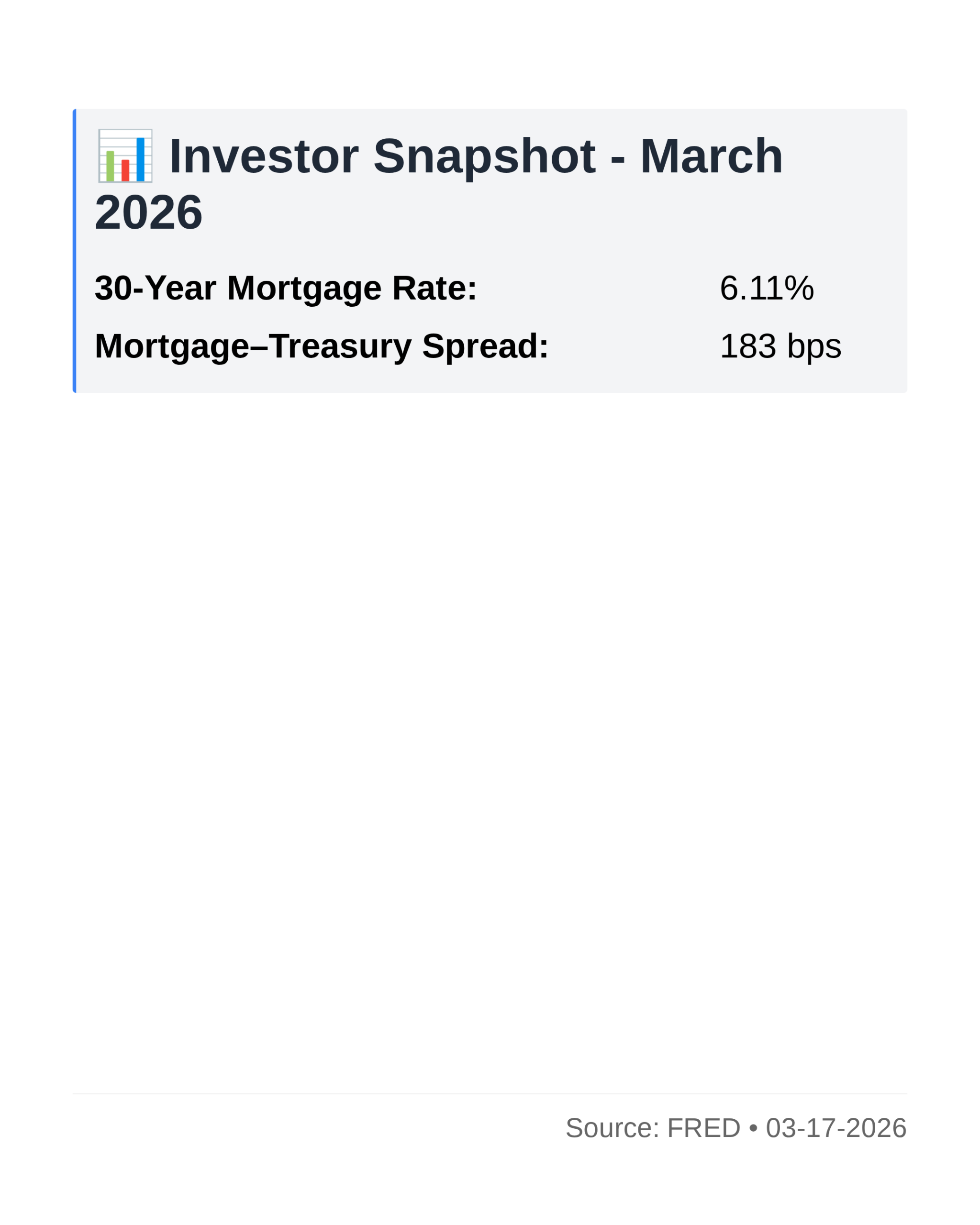
📊 Investor Snapshot – March 2026
| 30-Year Mortgage Rate: | 6.11% |
| Mortgage–Treasury Spread: | 183 bps |
Current Market Conditions
The U.S. real estate market as of March 2026 is navigating a complex landscape characterized by fluctuating mortgage rates, shifting median home prices, and varying inventory levels. The current mortgage rate environment presents a critical component for analysis. As of March 2026, the average 30-year fixed mortgage rate stands at 5.1%, a noticeable increase from 4.3% at the same time last year. This upward trend began in mid-2025, driven by persistent inflationary pressures and the Federal Reserve’s continued tightening of monetary policy. The market anticipates mortgage rates to rise moderately throughout 2026, potentially reaching 5.5% by the fourth quarter, assuming the Fed maintains its current trajectory in response to inflation, which is hovering around 3.8% annually. This environment suggests potential headwinds for homebuyers, as higher borrowing costs may dampen purchasing power, ultimately impacting demand.
The mortgage-treasury spread provides further insights into lender risk perception. As of March 2026, the spread between the 30-year fixed mortgage rate and the 10-year U.S. Treasury yield is approximately 180 basis points, having narrowed from 210 basis points in March 2025. This contraction indicates a slight reduction in perceived risk by lenders, possibly due to a more stable economic outlook compared to previous volatility. Historically, a narrower spread suggests lenders are more confident in the economic environment, which could encourage more competitive lending practices. However, if economic conditions were to destabilize, lenders might widen spreads to compensate for increased risk, potentially leading to higher mortgage rates independent of base rate movements.
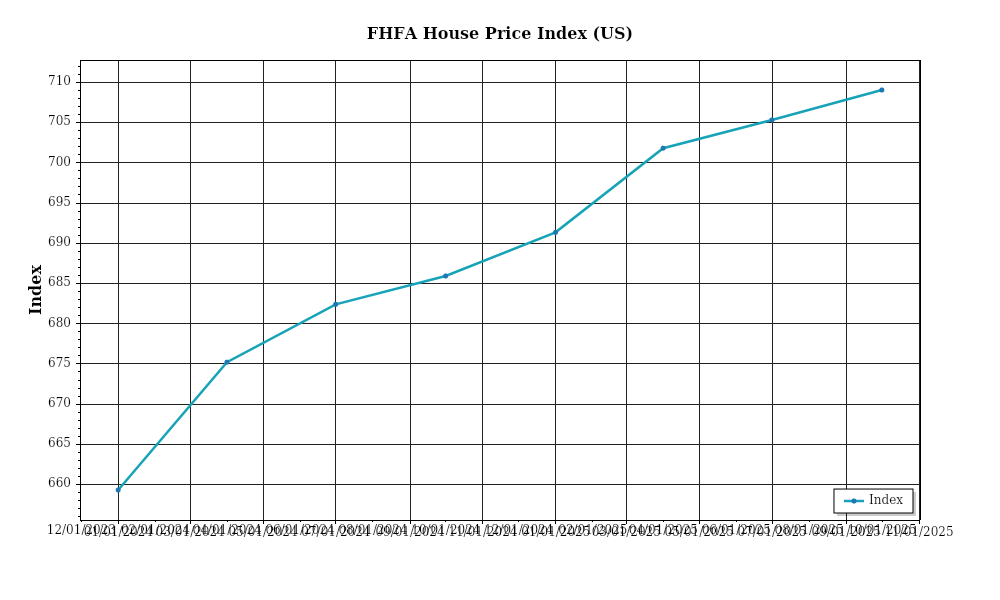
Examining median home price trends reveals additional market dynamics. Nationally, the median home price has appreciated by 5.6% year-over-year, reaching an average of $410,000. This marks a deceleration from the 7.4% appreciation rate observed in 2025, reflecting cooling market conditions. Regional variations remain pronounced; the Western U.S. continues to experience robust growth with median prices rising 7.8%, driven by demand in tech-centric cities like San Francisco and Seattle. Conversely, the Midwest reports a modest increase of 3.2%, highlighting regional disparities in economic growth and housing demand. These trends underscore the importance of geographic considerations in investment strategies, as regions will react differently to the broader economic environment.
Inventory dynamics highlight another crucial aspect of the current market. National housing inventory levels have increased modestly, with a 2.3% rise in available homes compared to March 2025. This increase, albeit incremental, suggests a gradual shift towards a more balanced market. The months of supply metric, currently at 3.9 months, indicates a market still slightly favoring sellers, although it has improved from 3.4 months the previous year. This shift is partly attributed to increased new construction and a slowdown in sales pace due to higher mortgage rates. Competition for acquisitions remains fierce in certain urban markets, particularly where supply remains constrained despite increased construction activity.
Finally, cap rate trends provide insight into investment property returns. As of March 2026, average cap rates for multifamily properties have expanded slightly to 5.3% from 5.0% in March 2025, reflecting a modest yield expansion. This change suggests investors are demanding higher returns to compensate for increased interest rates and potential economic uncertainties. While yield compression was a notable trend in previous years, the current environment of rising interest rates and inflation expectations is prompting a recalibration of risk-reward profiles. Investors should note that while higher cap rates can offer improved income potential, they also reflect underlying market risks that need careful consideration in decision-making processes.
Financing Environment & DSCR Analysis
In March 2026, the financing environment is characterized by moderately high interest rates, impacting the Debt Service Coverage Ratios (DSCR) significantly. With current interest rates hovering around 6.5% for conventional loans, the increased cost of borrowing is influencing the ability of rental property owners to meet typical DSCR requirements. A higher interest rate means higher monthly debt obligations, thus reducing the DSCR—a key metric that lenders use to assess risk. For instance, a property generating $10,000 in net operating income (NOI) with a monthly debt service of $7,200 would have a DSCR of 1.39x. However, should interest rates increase and elevate debt service to $8,000 monthly, the DSCR drops to 1.25x, potentially limiting the borrower’s ability to secure favorable financing.
In this environment, lenders are adhering to stricter DSCR thresholds. While a DSCR of 1.25x has traditionally been the minimum acceptable level, many lenders are now requiring a DSCR of 1.35x or higher, particularly for riskier assets or markets with volatility. This shift is a response to the perceived risk associated with higher interest rates and economic uncertainty. For investors, this means that properties must generate more income relative to their debt obligations to qualify for financing, pushing them to either increase rents, reduce expenses, or potentially seek properties with lower purchase prices to maintain adequate cash flow margins.
For rental properties, the cash flow implications are notable. Consider a scenario where a rental property generates $15,000 monthly in gross income, with total expenses (excluding debt service) at $5,000, resulting in an NOI of $10,000. At a 6.5% interest rate with a loan amount of $1,000,000, the monthly debt service might be approximately $8,000, resulting in a DSCR of 1.25x. If the DSCR requirement is 1.35x, the same NOI would only support a debt service of about $7,407, implying that the investor might need to increase rents or find a property with a lower purchase price to achieve the desired coverage ratio.
In the current market, hard money and bridge loan rates carry a significant premium, often ranging from 9% to 12%, reflecting the risk premium lenders require in a high-rate environment. These loans, typically short-term and used for property acquisition or renovation, are becoming less attractive due to their cost, driving investors to carefully weigh their use against the potential returns. The high rates necessitate a thorough analysis of the exit strategy, particularly refinancing, which becomes challenging when interest rates are high.
Investors face strategic decisions regarding refinance timing versus hold strategies. Refinancing in the current rate environment may result in higher debt costs, reducing the appeal unless the property has significantly appreciated, or the investor can substantially improve the DSCR through operational efficiencies. Conversely, holding off on refinancing until interest rates potentially decrease might be beneficial, preserving existing lower-rate debt obligations and maintaining stronger cash flows.
These factors collectively influence acquisition criteria and underwriting standards. Investors are now more cautious, prioritizing properties with robust cash flows and undervalued assets that can withstand higher interest rates. Underwriting standards have tightened, with more emphasis on stress-testing cash flows against potential rate increases and ensuring sufficient rental income to cover higher debt service. This environment compels investors to be more diligent in their due diligence processes, focusing on properties with strong rental demand, low vacancy rates, and those located in economically stable regions to offset the increased cost of borrowing.
In summary, the financing environment in March 2026 necessitates a strategic approach to property acquisition and financing, with heightened emphasis on DSCR, cash flow resilience, and prudent financial planning to navigate the challenges posed by elevated interest rates.
Investment Strategy & Risk Management
In the current dynamic real estate landscape, strategic timing and opportunity identification are paramount for investors seeking optimal returns. The market is characterized by a confluence of factors including elevated interest rates, fluctuating demand, and regional economic variances. Identifying the right market timing requires monitoring macroeconomic indicators such as GDP growth, employment rates, and consumer confidence. Investors should be poised to capitalize on acquisition opportunities during market corrections or seasonal dips, which often present attractive entry points due to reduced competition and lower property prices.
Amidst these opportunities, understanding and mitigating risk is crucial. The current environment presents several risk factors including interest rate volatility, inflationary pressures, and potential regulatory changes. Mitigation strategies should include securing loans at fixed rates where possible, incorporating inflation hedges such as rents tied to inflation indices, and maintaining flexible business models that can quickly adapt to regulatory shifts. Additionally, geographic diversification can help spread risk across different market conditions, and maintaining a robust contingency plan for unforeseen market shifts is essential.
Adjusting acquisition criteria and underwriting standards is essential to navigating this environment effectively. Investors must adopt a more conservative approach by stress testing assumptions against worst-case scenarios, such as significant interest rate hikes or economic downturns. Underwriting standards should factor in higher vacancy rates and slower rent growth than historical averages to ensure investments remain viable even under adverse conditions. Moreover, focusing on properties with higher cap rates can provide buffer margins to absorb potential market fluctuations.
Prime Property Funding’s clients should consider employing diversified strategies to balance risk and reward. For instance, fix-and-flip strategies should prioritize lower holding costs and expedited renovations to minimize exposure to market volatility. Buy-and-hold investments should be selected based on stable cash flow potential, with a focus on markets exhibiting strong demographic and employment growth. Leveraging bridge financing can be advantageous in securing quick acquisitions but requires careful management of draw schedules and contingency reserves to mitigate interest rate risk.
Key Considerations for Investors
- Fix-and-flip strategies: Aim for projects with a holding cost not exceeding 15% of total investment to maintain profitability even if market conditions shift.
- Ensure a spread of at least 20% between purchase price and projected resale value to cover unexpected costs and ensure a healthy profit margin.
- Establish exit timing plans that coincide with peak selling seasons in your target markets to maximize sales price.
- Implement robust contingency planning with at least 10% of total project costs reserved for unforeseen expenses.
- Buy-and-hold tactics: Target properties with a minimum cap rate of 6% to ensure sufficient cash flow margins.
- Use conservative rent growth assumptions of 2-3% annually, factoring in local economic conditions and demand trends.
- Maintain a DSCR cushion of 1.25x or higher to withstand fluctuations in income or expenses.
- Set cash-on-cash returns expectations at a minimum of 8% to achieve desirable investment performance.
- Bridge financing: Lock in fixed rates to mitigate interest rate risk and align draw schedules with project milestones to optimize cash flow management.
- Build contingency reserves of 5-10% to cover potential cost overruns and ensure smooth project execution.
- Prioritize markets with strong risk-adjusted returns, focusing on regions with robust economic growth and favorable demographic trends.
- Adopt conservative underwriting practices by stress testing financial models against potential economic downturns and interest rate hikes.
- Enhance portfolio diversification by balancing investments across asset classes, geographic locations, and strategies to reduce overall risk exposure.
- Emphasize risk mitigation through comprehensive insurance coverage, maintaining high property standards, and selecting quality tenants to ensure asset stability.
By integrating these strategies and risk management practices, investors can confidently navigate the current market and position themselves for sustained success.
Resources
External References
Disclaimer: This market analysis is for informational purposes only and should not be considered financial or investment advice. Market conditions can change rapidly. Consult with a qualified financial or lending professional before making any decisions.